PHYSICAL EDUCATION (048)
Class XII (2024-25)
TIME ALLOWED: 3 HRS MAX. MARKS: 70
GENERAL INSTRUCTIONS:
1) The question paper consists of 5 sections and 37 Questions.
2) Section A consists of question 1-18 carrying 1 mark each and is multiple choice questions. All questions are compulsory.
3) Sections B consist of questions 19-24 carrying 2 marks each and are very short answer types and should not exceed 60-90 words. Attempt any 5.
4) Sections C consist of Question 25-30 carrying 3 marks each and are short answer types and should not exceed 100-150 words. Attempt any 5.
5) Sections D consist of Question 31-33 carrying 4 marks each and are case studies. There is internal choice available.
6) Section E consists of Question 34-37 carrying 5 marks each and are short answer types and should not exceed 200-300 words. Attempt any 3.
(SECTION -A)
Q1. How many total matches will be played in a knock out fixture of 19 teams
A. 18
B. 17
C. 20
D. 16
View AnswerAns. A. 18
Q2. Given below are the two statements labeled Assertion (A) and Reason (R). Read 1 the statements and choose the appropriate option from the options given below:
Assertion: The knock out tournament is an elimination tournament
Reason: In knock out tournament, winner of each match advances in the tournament and the loser gets eliminated.
In the context of the above two statements, which one of the following is correct?
A. Both (A) and (R) are true and (R) is the correct explanation of (A).
B. Both (A) and (R) are true, but (R) is not the correct explanation of (A).
C. (A) is true, but (R) is false.
D. (A) is false, but (R) is true
View AnswerAns. A. Both (A) and (R) are true and (R) is the correct explanation of (A).
Q3. Match the following:

A. I-3, II-1, III-4, IV-2
B. I-1, II-3, III-4, IV-2
C. I-4, II-2, III-1, IV-3
D. I-2, II-3, III-4, IV-1
View AnswerAns. A. I-3, II-1, III-4, IV-2
Q4. For developing muscles, which nutrient should be increase in diet
A. Vitamins
B. Protein
C. Minerals
D. Carbohydrates
View AnswerAns. B. Protein
Q5. Identify the asana:
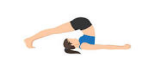
A. Paschimottanasana
B. Halasana
C. Vajrasana
D. Dhanurasana
View AnswerAns. B. Halasana
Q6. Which asana is pose like cobra?
A. Bhujangasana
B. Dhanurasana
C. Vajrasana
D. Ardhmatsyendrasana
View AnswerAns. A. Bhujangasana
Q7. Deaflympics Games was first organized in the year…………
A. 1896
B. 1960
C. 1924
D. 1951
View AnswerAns. C. 1924
Q8. Menarche is defined as the:
A. Ending of menstrual period of women
B. Beginning of menstrual period in women
C. Time of pregnancy
D. Missing of menstrual cycle
View AnswerAns. B. Beginning of menstrual period in women
Q9. Which of the following are fat soluble vitamins
A. Vitamin d & k
B. Vitamin b & c
C. Vitamin a & e
D. Both option a & c
View AnswerAns. D. Both option a & c
Q10. Match the following:

A. I-2, II-1, III-4, IV-3
B. I-2, II-3, III-1, IV-4
C. I-1, II-3, III-2, IV-4
D. I-2, II-3, III-4, IV-1
View AnswerAns. A. I-2, II-1, III-4, IV-3
Q11. Which of the following is a physiological factor determining flexibility?
A. Bone density
B. Joint structure
C. Cardiac output
D. Tidal Volume
View AnswerAns. B. Joint structure
Q12. The ability to tolerate higher concentration of ……………. Can help in improving endurance performance.
A. Lactic acid
C. acetic acid
B. Hydrochloric acid
D. Sulphuric acid
View AnswerAns. A. Lactic acid
Q13. If a ball is hit and it is stop by gravitational force, this is an example of which law of Motion.
A. Law of Inertia
B. Law of acceleration
C. Law of action and reaction
D. Both a & b
View AnswerAns. A. Law of Inertia
Q14. In which of the following sport friction plays the least important role.
A. Car race
B. Football
C. Ice skating
D. Hockey
View AnswerAns. C. Ice skating
Q15. Instrumental aggression is related to
A. Accepting defeat
B. Achieving goal
C. Only performance
View AnswerAns. B. Achieving goal
D. Hurting someone to gain something
Q16. Given below are the two statements labeled Assertion (A) and Reason (R).
Assertion: Aggression is part of human behavior and is necessary for an individual to live and struggle for higher achievements
Reason: Aggression is inevitable and inseparable in sport activities In the context of the above two statements, which one of the following is correct?
A. Both (A) and (R) are true and (R) is the correct explanation of (A).
B. Both (A) and (R) are true, but (R) is not the correct explanation of (A).
C. (A) is true, but (R) is false.
D. (A) is false, but (R) is true
View AnswerAns. A. Both (A) and (R) are true and (R) is the correct explanation of (A).
Q17. Which of these is a type of endurance?
A. Static
B. Specific
C. Dynamic
D. Relative
View AnswerAns. B. Specific
Q18. Which type of coordinative ability is required in game like judo and wrestling
A. Orientation ability
B. Coupling ability
C. Adaptation ability
D. Differentiation ability
View AnswerAns. C. Adaptation ability
(SECTION B- Attempt any 5)
Q19. Enlist any two-exercise guideline by WHO for different age groups.
View AnswerAns. a. Kyphosis
b. Lordosis
c. Scoliosis
d. Knock-Knee
e. Flat Foot
f. Bow legs
(any four)
Q20. How we can say that protein is an essential component of diet?
View AnswerAns. • Protein is essential component of diet because protein is known as building block of life and it increase the strength of muscle fibers, repair and maintenance of body tissue and also connected with immune mechanism of the body.
Q21. Mention the test performed on 9 to 18 yrs. of age group in SAI Khelo India fitness test and explain any one?
View AnswerAns. a. Body Composition (BMI)
b. Strength .
– Abdominal (Partial Curl-up)
– Muscular Endurance (Push Ups for Boys, Modified Push Ups for Girls)
c. Flexibility (Sit and Reach Test)
d. Cardiovascular Endurance (600 Meter Run/Walk)
e. Speed (50 mt. Dash)
Q22. List down the types of bone injuries.
View AnswerAns. a. Stress fracture
b. Green stick fracture
c. Comminuted fracture.
d. Transverse Fracture
e. Impacted fractures
Q23. What do you understand by the term goal setting
View AnswerAns. Goal setting is one of the best motivational strategies. It improves performance by directing attention, increasing effort and persistence. These goals can be short-term or long-term and are designed to help athletes focus their efforts, stay motivated, track progress, and ultimately improve their performance.
Q24. Define Flexibility and list down its type.
View AnswerAns. It is the ability which helps to do the movements with greater amplitude or with a great range of motion or we can say that flexibility refers to the range of movement in a joint or series of joints, and length in muscles that cross the joints to induce a bending movement or motion.
Type of Flexibility
a. active & passive
(SECTION C- Attempt any 5)
Q25. Specify the purpose of specific sports programme organised for community services.
View AnswerAns. These days it is very common that specific sports programmes are organised to make people aware regarding particular cause or any particular issue. These programmes are not related to competitions only, but it has special reason. They create awareness related to a disease like AIDS, Swine Flu, collecting funds for special cause like flood, earth quakes etc.
Q26. What are the health problem face by a woman due to female athlete triad in its sports and athletic performance?
View AnswerAns. The female athlete triad is a problem face by a women consist of Eating Disorder, Osteoporosis and Amenorrhea. The following problem are faced by a woman due to the female athlete triad in sports performance: –
a. Increased risk of injury
b. Feeling tired
c. Shortness of breath
d. Stomach inflammation
e. Muscle weakness
f. Weak bones
g. Hormonal imbalance
h. Psychological effects.
Q27. Write in detail the aims and objectives of special Olympic Bharat.
View AnswerAns. The Paralympic games are a multi – sports event for athletes with physical, mental and sensorial disabilities. This includes mobility, disabilities, amputees, visual disabilities. The main objective of Paralympics are as follows: –
a. Promote Para sport worldwide, without unlawful discrimination on the grounds of disability, race, skin colour, national, ethnic or social origin, age, sex, gender, sexual orientation, language, political or other opinion, religion or other beliefs, circumstances of birth, or other unlawful ground.
b. Support and encourage educational and cultural activities and exchanges that contribute to the development and promotion of the Paralympic Movement, enhance awareness of disability, and drive social inclusion.
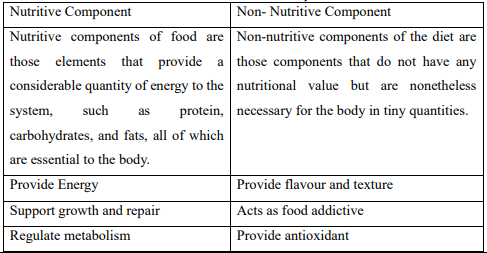
Q28. Differentiate between nutritive and nonnutritive components of a diet on the basis of their functions.
View AnswerAns.
Q29. With the help of suitable sports example explain the application of Newton’s third law in sports.
View AnswerAns. Newton’s third law states that for every action, there is an equal and opposite reaction.
In swimming, Newton’s third law is evident in the propulsion generated by a swimmer’s arm strokes against the water. When a swimmer pulls their arm through the water with force (action), the water exerts an equal and opposite force backward on the swimmer’s hand (reaction). This reaction force propels the swimmer forward through the water
Q30. How we can enhance the performance with the help of self-talk and self-esteem.
View AnswerAns. Self-talk and self-esteem play significant roles in enhancing sports performance. Motivational self-talks are necessary and productive. It boosts performance by helping you to build confidence, enhance your belief in your ability to perform. It also athletes maintain a positive mindset, enhance their confidence, and improve their performance.
Self-esteem is also crucial in sports performance. It helps in taking effective decision, Educed anxiety & stress. Individuals with high self-esteem are better equipped to bounce back from setbacks and failures.
(SECTION D)
Q31.
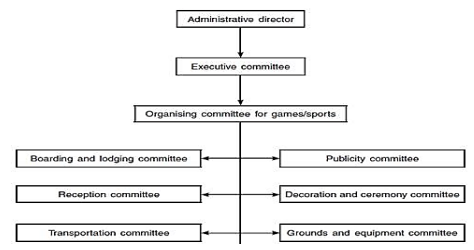
I. Choose the function of boarding committee
A. To take teams to the venue of match
B. To provide them meals
C. To take care of their stay
D. To arrange opening ceremony
View AnswerAns. C. To take care of their stay
II. What is the work of ceremony committee
A. To take teams to the venue of match
B. To provide them meals
C. To take care of their stay
D. To arrange opening ceremony
View AnswerAns. D. To arrange opening ceremony
III. Ground and equipment committee should not perform
A. To arrange teams match venues
B. To provide them meals
C. To take care of proper officiating
D. To make fixtures
View AnswerAns. B. To provide them meals
IV. Why committees are required?
A. To organize the event in perfect manner
B. To distribute the work
C. To make the best use of resources
D. All of the above
View AnswerAns. D. All of the above
(Questions for Visually impaired)
Ram is a secretary of state basketball association. He has given the responsibility to organize a subjunior national tournament. He wants to organize the event at large scale and start distribution the work in various committees. He delegates the duties to different individual with authority and responsibility.
(Answer the following questions on the basis of above paragraph)
I. Which committee is responsible to make the event awareness: –
A. Publicity Committee
B. Hospitality
C. Registration committee
D. Transports
II. ………………. is the process of identifying and grouping the work to be performed.
A. Planning
B. Directing
C. Organising
D. Controlling
III. The reception committee for the tournament is responsible for ________
A. Welcoming the participants
B. Arranging accommodation and meals for the participants
C. Proper upkeep of the venues
D. Welcoming the chief guest and spectators at the opening and closing ceremony
IV. If the responsibility of a committee is to fix venue, date and timing of the sports events, it is a ________
A. Post meeting committee
B. Pre meet committee
C. During meet committee
D. All the above
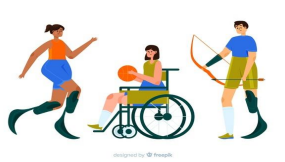
Q32.
I. The first paralympics was organise in
A.1960
C. 1965
B. 1970
D. 1985
View AnswerAns. A.1960
II. Special education is a branch of education that deals with
A. Educating children in special schools
B. Instructions designing for students with special needs
C. To provide opportunity of special education
D. More than one of the above
View AnswerAns. B. Instructions designing for students with special needs
III. Why is it called the Paralympics?
A. The first competition was held in Paraguay
B. It was originally for paramilitary soldiers injured in WW2
C. The event runs parallel with the Olympics
D. It’s an event for paraplegics
View AnswerAns. C. The event runs parallel with the Olympics
IV. What is the motto of the Paralympic Games
A. Spirit in motion
B. Citius, Altius, Fortius”
C. “Faster, Higher, Stronger
D. Diversity, Equality, Inclusion”
View AnswerAns. A. Spirit in motion
(Question for Visually Impaired)
Read the paragraph and answer the following question
The Paralympic Games are a major international multi-sport event involving athletes with a range of physical disabilities, including impaired muscle power, impaired passive range of movement, limb deficiency, leg length difference, short stature, hypertonia, ataxia, athetosis, vision impairment, and intellectual impairment.
Dr. Ludwig Guttmann known as father of Paralympic organized the first official Paralympic Games in Rome featuring 400 athletes from 23 countries.
The Paralympics have grown significantly over the years, now attracting thousands of athletes from over 100 countries. The Paralympic movement has played a vital role in challenging societal perceptions of disability and in promoting the rights and inclusion of people with disabilities worldwide
I. What is the primary focus of the Paralympic Games?
A. To promote physical fitness among children
B. To involve athletes with a range of physical disabilities in competitive sports
C. To honor the history of the Olympic Games
D. To raise funds for sports organizations
II. Who organized the first event that eventually led to the creation of the Paralympic Games?
A. Pierre de Coubertin
C. Lord Zeus
B. Dr. Ludwig Guttmann
D. Norabji Tata
III. In which year were the first official Paralympic Games held?
A. 1948
C. 1960
B. 1952
D. 1964
IV. Where were the first official Paralympic Games held?
A. Tokyo, Japan
C. Rome, Italy
B. London, United Kingdom
D. Sydney, Australia
Q33.
I. What is the primary effect of exercise on cardio respiratory system.
A. Decreased heart rate
B. Increased stroke volume
C. Decreased lung capacity
D. Decreased blood pressure
View AnswerAns. A. Decreased heart rate
II. What is stroke volume
A. The volume of blood ejected by the heart per minute
B. The volume of blood ejected by the heart per beat
C. The volume of blood in the ventricles at the end of diastole
D. The volume of blood pumped by the heart during exercise
View AnswerAns. A. The volume of blood ejected by the heart per minute
III. Cardiac output is
A. The volume of blood ejected by the heart per minute
B. The volume of blood ejected by the heart per beat
C. The volume of blood in the ventricles at the end of diastole
D. The volume of blood pumped by the heart during exercise
View AnswerAns. A. The volume of blood ejected by the heart per minute
IV. Blood pressure is
A. The volume of blood ejected by the heart per minute
B. The force exerted by blood against the walls of arteries
C. The rate of blood flow through the veins
D. The amount of oxygen carried by red blood cells
View AnswerAns. B. The force exerted by blood against the walls of arteries
(Question for blind)
Ramesh is an athlete of XYZ school. He is use to do 100m event for his school. He used to do hard work throughout the year to get his best performance. One day he got injury in winter season due to improper warming-up. He has been given first -aid before sent to hospital.
I. Sprain is an injury of ….
A. Ligament
C. Bone
B. Muscle
D. Joint
II. In PRICE treatment I stands for
A. Iceing
C. Incision
B. Incline
D. Irritation
III. Abrasion is a
A. Type of fracture
C. Soft tissue injury
B. Joint dislocation
D. Internal injury
IV. Why warming up is necessary
A. To avoid injuries
C. To increase body temperature
B. To increase pulse rate
D. All the above
(SECTION E- Attempt any 3)
Q34. List down any four asanas used for prevention of Hypertension. Explain the procedure, benefits and contraindicate of any one of them with help of a stick diagram.
View AnswerAns. Blood pressure is the force of your blood pushing against the walls of your arteries. Each time your heart beats, it pumps blood into the arteries.
The four asana used for the prevention of hypertension are as follows:-
• Tadasana,
• Katichakransan,
• Uttanpadasana,
• Ardha Halasana
Procedure benefit and contraindication of Tadasana:
Tadasana
The word Tada in Sanskrit means ‘palm tree’. This asana is called tadasana because in this asana the person stands straight like a aim tree stretching his whole body upwards.
Procedure:
To perform Tadasana the following steps should be performed:
1. Stand erect, feet together, hands by the side of the thighs. Keep the back straight and look in front.
2. Stretch the arms upward; keep them straight and parallel to each other in vertical position, with the palms facing each other.
3. Slowly, raise the heels as much as you can and stand on toes. Stretch body up as much as possible.
4. Maintain the position for 5-10 seconds comfortably.
5. To come back, bring the heels on the floor first. Slowly bring down the hands by side of the thighs and relax.
Benefits:
1. It gives stretch to whole body muscles.
2. It helps in strengthening thighs, knees and ankles.
3. By doing this asana regularly, children can increase their height.
4. It helps to remove laziness and lethargy.
Precautions
1. The inner upper arms should touch the respective ears.
2. Stretch the arms and fingers in full capacity.
3. Keep the head, neck and the body in one straight line.
4. Avoid bending forward or backward.
Contraindications
1. Those having complaints of vertigo should avoid practicing this asana.
Q35. Discuss the purpose of Rikli & Jones fitness test and explain procedure of any two test batteries in detail.
View AnswerAns. Even in old age, everybody wants to be able to continue to do what he wants, without pain, for as long as possible. It requires proper fitness during such age. In the beginning, there were not enough tests to assess the functional fitness. Recognizing the need for a tool to evaluate the functional fitness performance of older adults, Dr. Roberta Rikli and Dr. Jessie Jones developed the senior fitness test at Fullerton University. This test is also known as Fullerton Functional Test of senior citizens. The test is based on a functional fitness framework, which points out that being able to perform everyday activities.
1. Chair stand test for lower body 1. Lower body strength, leg strength & strength Endurance
2. Arm curl test for upper body 2. The upper body strength, arm flexor, strength, strength & endurance
3. Chair sit & reach test for lower 3. The lower back flexibility body flexibility
4. Back-scratch test for upper body 4. The upper body flexibility of the body flexibility & range of motion of the shoulders.
5. Eight foot up & Go test for agility 5. The motor agility, speed & balance
6. Six minute walk test for 6. Cardio-vascular endurance & recovery
Chair Stand Test for Lower Body Strength
Purpose: The purpose of the Chair-Stand is to measure the strength of lower body of adults over 60 years of age. Lower body strength is important for activities such as getting out of a chair, on the bus, out of the car, and rising up from a kneeling position in the house or garden. The strength of your lower body can directly affect the ease with which you perform the activities you do every day.
Equipment required: A straight back or folding chair without arm rests (seat 17 inches/44 cm high), stopwatch.
Procedure:
1) Place the chair against a wall where it will be stable.
2) Sit in the middle of the chair with your feet flat on the floor, shoulder width apart, back straight.
3) Cross your arms at the wrist and place them close to the chest.
4) On the command ‘go’ you will rise up to a full stand and sit again as many times as you can during the 30 second interval.
5) Count the total number of complete chair stands (up and down equals one stand). If the subject has completed a full stand from the sitting position when the time is elapsed, the final stand is counted in the total.
Scoring: The score is the number of completed chair stands in 30 seconds. Below is a table showing the recommended ranges for this test based on age groups.
Arm Curl (Bicep) Test for Upper Body Strength
Purpose: This test measures upper body strength and endurance.
Equipment required: 5-pound weight (women), 8-pound weight (for men). A chair without arm rests, stopwatch.
Procedure:
1) The subject sits on the chair holding the weight in the hand using a suitcase grip (palm facing towards the body).
2) This test is conducted on the dominant arm side (or stronger side).
3) On the command ‘go’ do as many curls as you can in the allotted 30 second time period.
4) Do not swing the weight.
5) If you have started raising the weight again and are over halfway up when time is called, you may count that curl.
Scoring: The score is the total number of controlled arm curls performed in 30 seconds. Below is a table showing some recommended ranges for this test based on age groups.
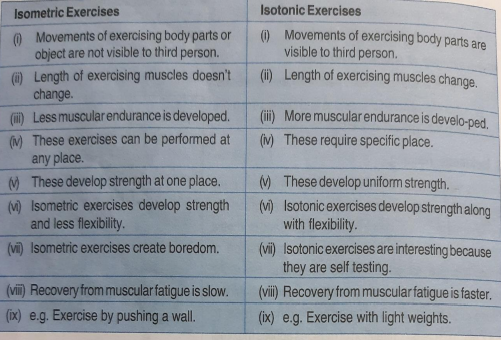
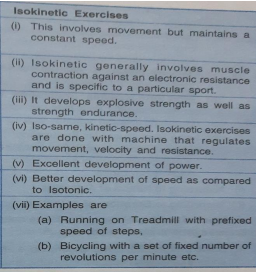
Q36.Define strength and differentiate between Isometric, Iso-tonic and Iso-kinetic exercises.
View AnswerAns. Strength is the ability of muscles to overcome the resistance. Strength is necessary for the performance of physical activities, whether it is a physical activity associated with daily living.
Barrow and McGee have defined “Strength as, ‘The Capacity of the whole body or any of it’s ports to exert force.’
Q37.What are the various types of friction? With the help of suitable example explain why friction is necessary in sports.
View AnswerAns. A. Friction is a force which oppose efforts to slide or roll one body over another. Without friction it would be impossible to walk or run but on the other hand it increases the difficulty of moving.
The amount of friction between one surface and another depends upon the nature of the surface and forces pressing them together generally speaking smooth surface have less friction than rough.
Types of Friction:-
• Static Friction:- is the opposing force which acts between two surface in which one tends to move over the other
• Dynamic Friction:- which acts between two surfaces in which one is actually moving over the other it may be two types.
– Sliding
– Rolling
Friction is both helpful in sports: Friction is Necessary: Nothing would be able to move without friction. Friction is how things accelerate. Without friction we would not be able to walk we would just be slipping. Without friction we cannot give better performance in sports. Examples: athletes use spikes and footballers use studs to have appropriate friction while they run fast. A Gymnast uses lime powder on his/her palms to perform many activities like horizontal bar uneven bar Roman Rings. In Badminton players are usually seen to rub their sole of shoes with lime before going to the wooden court. It is done to provide better grip on the floor so that one can move safely