Social Science (087)
Class IX (2024-25)
Time Allowed: 3 hours Maximum Marks: 80
General Instructions:
1. The question paper comprises Six Sections – A, B, C, D, E and F. There are 37 questions in the Question paper. All questions are compulsory.
2. Section A – From questions 1 to 20 are MCQs of 1 mark each.
3. Section B – Question no. 21 to 24 are Very Short Answer Type Questions, carrying 2 marks each. Answer to each question should not exceed 40 words.
4. Section C contains Q.25to Q. 29 are Short Answer Type Questions, carrying 3 marks each. Answer to each question should not exceed 60 words.
5. Section D – Question no. 30 to 33 are long answer type questions, carrying 5 marks each. Answer to each question should not exceed 120 words.
6. Section-E – Questions no from 34 to 36 are case based questions with three sub questions and are of 4 marks each. Answer to each question should not exceed 100 words.
7. Section F – Question no. 37 is map based, carrying 5 marks with two parts, 37a from History (2 marks) and 37b from Geography (3 marks).
8. There is no overall choice in the question paper. However, an internal choice has been provided in few questions. Only one of the choices in such questions must be attempted.
Section A
1. Which of the following Right seek the enforcement of fundamental rights?
a) Right to Constitutional Remedies
b) Right to equality
c) Right to Enforcement
d) Right to freedom
View AnswerAns. a) Right to Constitutional Remedies
2. Quarrying and mining are included in the:
a) Government sector
b) Secondary sector
c) Tertiary sector
d) Primary sector
View AnswerAns. d) Primary sector
3. Read the given table that shows some important features of PDS in India. Read the data and select the appropriate option from the following.
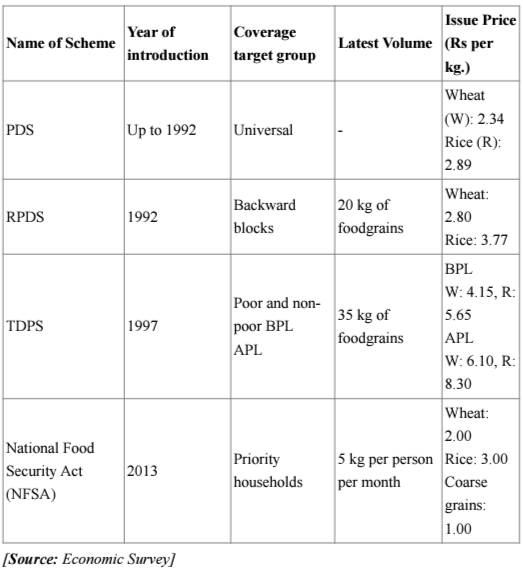
In which year the scheme with differential price policy was adopted?
a) 1990
b) 1997
c) 2013
d) 1992
View AnswerAns. b) 1997
4. Which of the following is true with reference to the resignation of Prime Minister ?
A. If he/she resigns the entire ministry quits.
B. The Prime Minister gives his resignation to the Speaker of the Lok Sabha.
a) Both A and B are false
b) A is true but B is false
c) Both A and B are true
d) A is false but B is true
View AnswerAns. b) A is true but B is false
5. World War Second began with the German invasion of
a) Chezkoslovakia
b) Poland
c) Austria
d) France
View AnswerAns. b) Poland
6. ________ is/are the real source of power in a democratic country.
a) The judiciary
b) People
c) The parliament
d) Aristocrats
View AnswerAns. b) People
7. Assertion (A): Robespierre was the leader of the Jacobins club and his rule is referred to as the Reign of Terror.
Reason (R): He followed a policy of severe control and punishment.
a) Both A and R are true and R is the correct explanation of A.
b) Both A and R are true but R is not the correct explanation of A.
c) A is true but R is false.
d) A is false but R is true.
View AnswerAns. a) Both A and R are true and R is the correct explanation of A.
8. Village Palampur is situated about 10 kilometres west of Surat. In a village, males of families work as labourers while the females are responsible for household jobs. The income of all the families in the village is meagre. Subsequently, the programme was launched by the government. Under this programme, a collective group was formed by 15 women. Each member of the group deposits Rs. 100 as savings every month. To meet their needs, members can take small loans from the group itself or through a mix of bank credit and government subsidy. Based on the above case, name the programme by which government organised women into selfhelp groups.
a) Prime Minister Rozgar Yozana
b) Swarnajayanti Gram Swarozgar Yojana
c) Rural Employment Generation Programme
d) Pradhan Mantri Gramodaya Yozana
View AnswerAns. b) Swarnajayanti Gram Swarozgar Yojana
9. For how many days the Rajya Sabha can delay a money bill?
a) 14 Days
b) 12 Days
c) 10 Days
d) 16 Days
View AnswerAns. a) 14 Days
10. On the given map of France, A is marked as a place where troops entered following the King’s command. Identify it from the following options.
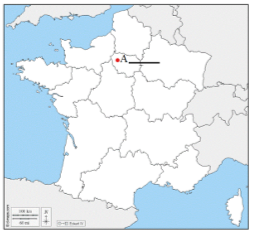
a) Paris
b) Nantes
c) Marseillaise
d) Bastille
View AnswerAns. a) Paris
11. Which of the following is/are true with reference to Chief Election Commissioner ?
A. He/She is appointed by the President.
B. Once appointed, he/she is not answerable to the President or the government.
a) A is false but B is true
b) A is true but B is false
c) Both A and B are false
d) Both A and B are true
View AnswerAns. d) Both A and B are true
12. How many members are elected to the National People’s Congress from all over China?
a) 2000
b) 3050
c) 4000
d) 3000
View AnswerAns. d) 3000
13. Arrange the following in correct sequence with respect to the period in which the event occurred:
i. Fire Decree declared
ii. Second World War
iii. Enabling Act was passed
iv. Hitler became Chancellor of Germany
a) ii, iv, i, iii
b) i, iv, iii, ii
c) i, ii, iii, iv
d) ii, iv, iii, i
View AnswerAns. a) ii, iv, i, iii
14. Read the information given below and select the correct option
The Constitution began with a Declaration of the Rights of Man and Citizen. Rights were established as ‘natural and inalienable’ rights, that is, they belonged to each human being by birth and could not be taken away. It was the duty of the state to protect each citizen’s natural rights. With the help of given information, choose which of the following rights was not established as ‘natural and inalienable’ rights?
a) Right to life
b) Freedom of speech
c) Freedom of opinion
d) Right to constitutional remedies
View AnswerAns. d) Right to constitutional remedies
15. Amnesty International is an international organisation for
a) human rights
b) world peace
c) justice
d) restoring democracy
View AnswerAns. a) human rights
16. From Gujarat to Arunachal Pradesh, there is a time lag of two hours. There is a standard time taken on a place of a state marked as A in the given map. Identify this place from the following options.
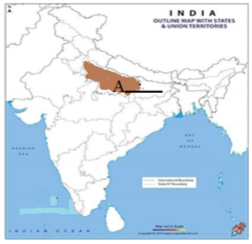
a) Chhattisgarh
b) Madhya Pradesh
c) Uttar Pradesh
d) Uttarakhand
View AnswerAns. c) Uttar Pradesh
17. Which of the following river form braided channels?
a) Godavari
b) Brahmaputra
c) Krishna
d) Narmada
View AnswerAns. b) Brahmaputra
18. Who is known as the Father of Communism?
a) Father Gapon
b) Robert Owen
c) Lenin
d) Karl Marx
View AnswerAns. d) Karl Marx
19. In which sector new services like biotechnology and information technology are now appearing?
a) Tertiary
b) Manufacturing
c) Secondary
d) Primary
View AnswerAns. a) Tertiary
20. Uttarakhand, Uttar Pradesh, Bihar, West Bengal and Sikkim have common frontiers with
a) Myanmar
b) Bhutan
c) China
d) Nepal
View AnswerAns. d) Nepal
Section B
21. Describe Corals?
View AnswerAns. A. Coral Polyps are short lived microscopic organisms, which live in colonies.
B. They flourish in shallow, mud free and warm waters.
C. They secrete hard rock like substance.
D. The coral secretion and their skeletons from coral deposits in the form of reefs.
E. They are mainly of three kinds- barrier reefs, fringing reef and atolls.
F. The Great Barrier Reef of Australia is good example of the first kind of coral reefs.
G. Atolls are circular or horse shoe shaped coral reefs.
22. Explain Disguised Employment.
View AnswerAns. A. This type of unemployment is a typical of the agricultural sector where more people are working on a piece of farm than are required.
B. The unemployment is hidden but the acid test of the unemployed force comes when they are withdrawn from the field and it does not lead to fall in production.
OR
Explain briefly the term ‘unemployment’.
View AnswerAns. A. Unemployment refers to a situation where all able and willing persons are not able to find work at the prevailing wage rate or activities to provide them with a means of living.
B. The person cannot be counted as unemployed if he does not fall within the age group of 15-59 years.
C. Further, if the person is not willing to work, then also we not be considered as unemployed.
23. What is indirect democracy?
View AnswerAns. In indirect democracy, people indirectly participate in the government through representatives. It is the political system where representatives responsible to make laws for the citizens are elected by them. These representatives act on behalf of the citizens in the parliament and voice their aspirations and problems.
24. Which regions of India are prone to the food insecurity?
View AnswerAns. A. The food insecure people are disproportionately large in some regions of the country, such as economically backward states with high incidence of poverty, tribal and remote areas, regions more prone to natural disasters and food insecurity. B. In fact, the states of Uttar Pradesh (Eastern and south-eastern parts), Bihar, Jharkhand, Odisha, West Bengal, Chhattisgarh, parts of Madhya Pradesh and Maharashtra account for largest number of food insecure people in the country.
Section C
25. Why were the FCI granaries overflowing with food grains and how was the situation controlled?
View AnswerAns. (i) In July 2002, the stock of wheat and rice with FCI was 63 million tonnes which was much more than the minimum buffer norms of 24.3 million tonnes.
(ii) The stock eased after 2002-03 due to relief operations undertaken by the government as the year was declared as drought year due to failure of monsoon.
(iii) The decline in stocks continued in subsequent years. However, these remained consistently higher than the buffer norms. The situation improved with the distribution of food grains under different schemes launched by the government.
26. Highlight the ideology of Conservatives?
View AnswerAns. A. They opposed to liberals and radicals. In the 18th century, they were generally opposed to the idea of change.
B. By the 19th century, they accepted that some changes were necessary, but through a slow process.
C. They believed in old or past tradition and customs.
OR
When was provincial government established and how it was overthrown by Lenin?
View AnswerAns. i. The provincial Government which was established after February revolution of 1917 was controlled by landlords, industrialists and army officials.
ii. Lenin was against the Provincial Government. He brought together different Soviets and prepared them for revolution.
iii. It was under the leadership of Lenin that the Provincial Government was overthrown by soviets. On 16th October 1917, Lenin persuaded the Petrograd Soviet and the Bolshevik Party to agree to a socialist seizure of power.
27. “Resources, calamities and disasters all are meaningful only in relation to human beings”. Explain the statement with suitable arguments.
View AnswerAns. i. The statement highlights the importance of human resource:
a. It is the people who develop the economy and society.
b. It is the people who make and use resources.
c. Resources have no meaning without people. e.g. coal is just a piece of rock until people were able to make it usable.
ii. Natural events like a river flood or Tsunami become a ‘disaster’ only when they affect a crowded settlement.
iii. The population is the pivotal element from which the significance is derived.
Thus, resources, calamities and disasters are all meaningful only in relation to human beings.
28. How does electoral competition help the political parties and leaders to win the elections?
View AnswerAns. (i) Regular electoral competitions provide incentives to political parties and leaders.
(ii) They know that if they raise issues that people want to be raised, their popularity and chances of victory will increase in the next elections.
(iii) But if they fail to satisfy the voters with their work, they will not be able to win again.
29. What are the limitations of a coalition Government?
View AnswerAns. A. The Prime Ministers has to accommodate different groups and factions in his party as well as alliance partners.
B. He also has to pay heed to the views and positions of coalition’s partners and other parties, on whose support the survival of the government depends.
C. The agenda and the policies of the government are usually decided as a common minimum programmes. This includes only those policies which are common to all coalition partners.
Section D
30. How did the fall of Bastille prison become the immediate cause of French Revolution?
View AnswerAns. A. On the morning of 14th July 1789, the city of Paris was in a state of alarm. The king ordered his troops to move into the city. Rumours spread that he would soon order the army to open fire upon the citizens.
B. Some 7,000 men and women gathered in front of the town hall and decided to form a people’s militia.
C. A group of several hundred people marched towards the eastern part of the city and stormed the fortress-prison, the Bastille.
D. In the armed fight, the commander of Bastille was killed and prisoners released. Since the Bastille stood for the despotic power of the king, it led people towards the success of French Revolution.
OR
Who represented the National Assembly on 5th May 1789?
View AnswerAns. A. On 5th May 1789, Louis XVI called together an assembly of Estates General to pass proposals for new taxes.
B. A resplendent hall in Versailles was prepared to host the delegates.
C. The first and second estates sent 300 representatives each, who were seated in rows facing each other on two sides, while the 600 members of the third estate had to stand at the back.
D. The third estate was represented by its more prosperous and educated members. Peasants, artisans and women were denied entry to the assembly. However, their grievances and demands were listed in some 40,000 letters which the representatives had brought with them.
31. Give reasons as to why.
i. Seasonal reversal of wind direction takes place over the Indian subcontinent?
View AnswerAns. Seasonal reversal of wind direction over the Indian subcontinent takes place due to pressure differential. El Nino has major role to play in the seasonal reversal of wind direction over the Indian subcontinent.
ii. The bulk of rainfall in India is concentrated over a few months.
View AnswerAns. The monsoon begins from the first week of June and advances quite rapidly to cover almost the whole country by mid-July. Hence, the bulk of rainfall in India is concentrated over the months of a few months; mainly June to August
iii. The Tamil Nadu coast receives winter rainfall.
View AnswerAns. The Tami Nadu coast receives winter rainfall because of movement of low-pressure conditions to the Bay of Bengal.
iv. The delta region of the eastern coast is frequently struck by cyclones.
View AnswerAns. The Bay of Bengal is the centre of various pressure changes and hence there is always a chance of development of cyclone. Due to this, the delta region of the eastern coast is frequently struck by cyclones.
v. Parts of Rajasthan, Gujarat and the leeward side of the Western Ghats are drought-prone.
View AnswerAns. The parts fall in the rain shadow area of the Aravalli. Hence, they are drought-prone and don’t receive much of rainfall.
OR
“Indian monsoon is said to be a unifying bond for the people of the country.” Suppose the monsoon is disturbed for a prolonged period of time. What do you think, how will it affect the country?
View AnswerAns. A bad or disturbed monsoon can affect the country in many ways:
i. There will be a change in the landscape.
ii. The fauna and flora will be disturbed.
iii. Due to the change in the cycle of the season, the Indian agricultural cycle will be disturbed.
Iv. Many of the festivals like Baisakhi, Pongal, Onam, Bihu, etc will come to an end.
v. There will be a shortage of food and drinking water in the country.
vi. There will be a decline in the export and increase in import affecting the economy of the country.
vii. The poor will be affected the most as essential things will be beyond their reach.
viii. The per capita income and the national income of the country will be affected due to more imports and less exports.
ix. A number of river water disputes will take place not only between countries but also among states
32. Describe the policy of government in the field of education.
View AnswerAns. According to National Education Policy, 1986, the government considers human resource, a positive asset which needs to be cherished, nurtured and developed. Following efforts are made for the same:
I. Education contributes towards the growth of society. It enhances the national efficiency of governance.
II. There is a provision made for providing universal access, retention and quality in elementary education with special emphasis on girl-education.
III. There is also an establishment of pace setting of schools like Navodaya Vidyalaya in each district.
IV. Vocational streams have been developed to equip large number of high school students with occupations related to knowledge and skills.
V. The plan outlay on education has increased from 151 crore in the first plan to 43,825 crore in the tenth Plan. Literacy rate has increased from 18% in 1951 to 65% in 2001.
OR
“Human resource is an indispensable factor of production”. Elucidate.
View AnswerAns. Human resource is a way of referring to a country’s working people in terms of their existing productive skills and abilities. Every activity needs factors like land, labour, physical capital and human capital for its production. No production activity is possible without human factors. It is a human resource that makes other resources useful by their wisdom and endeavours. Human resource is not only an essential factor of production but also an important element for other factors of production. It is the human resource that operates every sector of the economy whether Primary sector like agriculture, Secondary sectors like automobile manufacturing or Tertiary sector like financial services. No resource on this Earth can become useful without human endeavour. So, human resource is an indispensable factor of production.
33. “The South African Constitution inspires democrats all over the world”. Explain.
View AnswerAns. A. The South African Constitution inspires democrats all over the world.
B. A state denounced by the entire world till recently as the most undemocratic one is now seen as a model of democracy.
C. What made this change possible was the determination of the South African people to work together, to transform bitter experience into the binding glue of a rainbow nation.
D. After two years of discussion and debate they came out with one of the finest constitutions the world has ever had. This constitution gave to its citizens the most extensive rights available in any country. Together, they decided that in the search for a solution to the problems, nobody should be excluded, no one should be treated as a demon. They agreed that everybody should become part of the solution, whatever they might have done or represented in the past.
E. The Preamble to the South African Constitution sums up the spirit.
OR
Highlight the salient features of the Constitution of India.
View AnswerAns. The salient features of the Constitution of India are:
i. India has the biggest Constitution in the world with a number of articles, schedules, and parts.
ii. Every part of the Constitution can be amended by Parliament except its ‘basic structure’. Any law which violates the basic structure of the Constitution is declared unconstitutional and invalid by the court.
iii. The Constitution provides certain fundamental rights to the citizens which are legally enforceable by the court of law.
iv. It provides certain, “Directive Principles of State Policy”, which are not legally enforceable by the court of law. These principles promote social and economic democracy and aim to establish India as a welfare state.
v. It provides for the universal adult franchise as a basis of elections to the Lok Sabha and the state legislative assemblies.
vi. It declares India a socialist, democratic and secular state.
Section E
34. Read the following text carefully and answer the questions that follow:
Under the shadow of war, the Nazis proceeded to realise their murderous, racial ideal. Genocide and war became two sides of the same coin. Occupied Poland was divided up. Much of north-western Poland was annexed to Germany. Poles were forced to leave their homes and properties behind to be occupied by ethnic Germans brought in from occupied Europe. Poles were then herded like cattle in the other part called the General Government, the destination of all ‘undesirables’ of the empire. Members of the Polish intelligentsia were murdered in large numbers in order to keep the entire people intellectually and spiritually servile. Polish children who looked like Aryans were forcibly snatched from their mothers and examined by ‘race experts’. If they passed the race tests they were raised in German families and if not, they were deposited in orphanages where most perished. With some of the largest ghettos and gas chambers, the General Government also served as the killing fields for the Jews.
i. Which ideology of the Nazis do the given passage reflect?
View AnswerAns. The Racial Utopia of the Nazis.
ii. Under which law marriages between Jews and Germans were forbidden?
View AnswerAns. Under the Nuremberg Laws of citizenship of September 1935 marriages between Jews and Germans were forbidden.
iii. Explain the night of broken glass under the Nazi regime.
View AnswerAns. On the night of November 9-10, 1938, the Nazi regime coordinated a wave of antisemitic violence in Nazi Germany. This became known as Kristallnacht or the “Night of Broken Glass.” Jewish properties were vandalised and looted, houses attacked, synagogues burnt, and men arrested in a pogrom in November.
35. Read the following text carefully and answer the questions that follow:
India is one of the most ancient civilizations in the world. It has achieved multifaceted socio-economic progress during the last five decades. It has moved forward displaying remarkable progress in the field of agriculture, industry, technology, and overall economic development. India has also contributed significantly to the making of world history. India is a vast country. Lying entirely in the Northern hemisphere the mainland extends between latitudes 8°4’N and 37°6’N and longitudes 68°7’E and 97°25’E. The Tropic of Cancer divides the country into almost two equal parts. To the southeast and southwest of the mainland, lie the Andaman and Nicobar Islands and the Lakshadweep islands in the Bay of Bengal and the Arabian Sea respectively.
i. What is the latitudinal position of India?
View AnswerAns. 8°4’N and 37°6’N
ii. What is the longitude-wise location of India?
View AnswerAns. 68°7’E and 97°25’E
iii. Which latitudinal line divides India into approximately two equal parts? What is the latitudinal value of this line?
View AnswerAns. The latitudinal line that divides India into two equal parts is the Tropic of Cancer. Its latitudinal value is 23 1/2 N.
36. Read the following text carefully and answer the questions that follow:
Mahatma Gandhi National Rural Employment Guarantee Act, 2005 aims to provide 100 days of wage employment to every household to ensure livelihood security in rural areas. It also aimed at sustainable development to address the cause of drought, deforestation and soil erosion. One-third of the proposed jobs have been reserved for women. Prime Minister Rozgar Yozana is another scheme which was started in 1993. The aim of the programme is to create self-employment opportunities for educated unemployed youth in rural areas and small towns. They are helped in setting up small business and industries. Rural Employment Generation Programme was launched in 1995. The aim of the programme is to create self-employment opportunities in rural areas and small towns. A target for creating 25 lakh new jobs has been set for the programme under the Tenth Five Year plan. Swarnajayanti Gram Swarozgar Yojana was launched in 1999. The programme aims at bringing the assisted poor families above the poverty line by organising them into self help groups through a mix of bank credit and government subsidy. Under the Pradhan Mantri Gramodaya Yozana launched in 2000, additional central assistance is given to states for basic services such as primary health, primary education, rural shelter, rural drinking water and rural electrification. The results of these programmes have been mixed. One of the major reasons for less effectiveness is the lack of proper implementation and right targeting. Moreover, there has been a lot of overlapping of schemes. Despite good intentions, the benefits of these schemes are not fully reached to the deserving poor. Therefore, the major emphasis in recent years is on proper monitoring of all the poverty alleviation programmes.
i. Explain any one cause for the less effectiveness of poverty alleviation programmes?
View AnswerAns. i. Any ONE point
i. It is due to a lack of proper implementation and the right targeting.
ii. There also has been a lot of overlapping of schemes.
iii. Despite good intentions, the benefits of these schemes have not fully reached the poor.
ii. Explain any two features of the Mahatma Gandhi National Rural Employment Guarantee Act 2005?
View AnswerAns. Any two points
1. Mahatma Gandhi National Rural Employment Guarantee Act, 2005 aims to provide 100 days of wage employment to every household to ensure livelihood security in rural areas.
2. It also aimed at sustainable development to address the cause of drought, deforestation, and soil erosion.
3. One-third of the proposed jobs have been reserved for women.
iii. What objectives did SGSY have?
View AnswerAns. iii. The Swarnajayanti Gram Swarozgar Yojana was launched in 1999. It aims at bringing up the assisted poor families above the poverty line by organizing them into self-help groups through a mix of bank credit and government subsidy.
Section F
37. i. Two places A and B have been marked on the given outline map of the world. Identify then and write their correct names on the lines drawn near them A.
A. The place where they gave economic prosperity to the flourishing slave trade. B.
B. The place where Territories under German expansion.
View AnswerAns. A. Nantes
B. Denmark
ii. On the outline map of India locate and label ANY THREE of the following with suitable Symbols.
a. Rajaji – Wild Life Sanctuaries
b. Corbett – National Parks
c. Anai Mudi – Mountain Peaks
d. The Narmada – The Peninsular rivers
View AnswerAns.