Subject: Science
Time Allowed: 3 hours Maximum Marks: 80
General Instructions:
1. This question paper consists of 39 questions in 5 sections.
2. All questions are compulsory. However, an internal choice is provided in some questions. A student is expected to attempt only one of these questions.
3. Section A consists of 20 objective type questions carrying 1 mark each.
4. Section B consists of 6 Very Short questions carrying 02 marks each. Answers to these questions should in the range of 30 to 50 words.
5. Section C consists of 7 Short Answer type questions carrying 03 marks each. Answers to these questions should in the range of 50 to 80 words.
6. Section D consists of 3 Long Answer type questions carrying 05 marks each. Answer to these questions should be in the range of 80 to 120 words.
7. Section E consists of 3 source-based/case-based units of assessment of 04 marks each with sub-parts.
Section A
1. The name of A, B, C and D in the following diagram are:

a) A – Solidification, B – Vaporisation, C Fusion, D – Condensation
b) A – Vapourisation, B – Fusion, C Condensation, D – Solidification
c) A – Fusion, B – Vaporisation, C Condensation, D – Solidification
d) A – Condensation, B – Vaporisation, C Solidification, D – Fusion
View AnswerAns. c) A – Fusion, B – Vaporisation, C Condensation, D – Solidification
2. A eukaryotic nucleus has a:
a) non-porous, single membrane
b) porous, single membrane
c) porous, double membrane
d) non-porous, double membrane
View AnswerAns. c) porous, double membrane
3. Two racing cars of masses m1 and m2 are moving in circles of radii r1 and r2 respectively. Their speeds are such that each makes a complete circle in the same length of time T. The ratio of angular speed of the first car to that of the second car is
a) r1 : r2
b) 1 : 1
c) m1r2, : m1r2
d) m1 : m2
View AnswerAns. b) 1 : 1
4. What is the pulse rate of buffalo/minute?
a) 40–60/minute
b) 16–18/minute
c) 70–72/minute
d) 40–45/minute
View AnswerAns. a) 40–60/minute
5. The smooth muscle consists of _______________. Each fibre contains a single oval nucleus in its thick middle part. The cross-striations are absent so that the fibres look smooth, hence the name unstriated.
a) straight, wide unbranched spindle-shaped fibres
b) long, narrow unbranched spindle-shaped fibres
c) long, wide and spindle-shaped tissues
d) short, wide unbranched spindle-shaped fibres
View AnswerAns. b) long, narrow unbranched spindle-shaped fibres
6. Which of the following is absent in plant cells?
a) Cell membrane
b) Vacuole
c) Mitochondria
d) Centriole
View AnswerAns. d) Centriole
7. The number of molecules in CuSO4.5H2O bonded by H-bond is
a) 5
b) 3
c) 2
d) 1
View AnswerAns. d) 1
8. Girth of stem increases due to
a) apical meristem
b) vertical meristem
c) intercalary meristem
d) lateral meristem
View AnswerAns. d) lateral meristem
9. The least count of the spring balance shown in the diagram is:
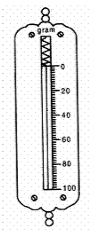
a) 1 g
b) 2 g
c) 0.5 g
d) 5 g
View AnswerAns. b) 2 g
10. A signal from a space ship reaches the ground in 5 minutes. What was the distance of the space ship from the ground station? The speed of the signal is 3 x 10⁸ m/s

Ans. Option (c)
11. Statement 1: Isobars have different chemical properties.
Statement 2: The sum of protons and neutrons in isobars is always different.
a) Statement 1 is true and statement 2 is false.
b) Both statements 1 and 2 are true but statement 2 is not the correct explanation of statement 1.
c) Both statements 1 and 2 are true and statement 2 is the correct explanation of statement 1.
d) Both statements 1 and 2 are false.
View AnswerAns. a) Statement 1 is true and statement 2 is false.
12. Which of the following is non – vascular?
a) Epithelial tissue
b) Muscular tissue
c) Connective tissue
d) Nervous tissue
View AnswerAns. a) Epithelial tissue
13. “Viruses are non-cellular organisms” – this statement is a:
a) Partially false
b) True statement
c) False statement
d) Partially true
View AnswerAns. b) True statement
14. Fermentation of grapes is an example of
a) Redox reaction
b) Reversible change
c) Chemical change
d) Physical change
View AnswerAns. c) Chemical change
15. A food sample was tested for the presence of components P, G, R and S and the following chromatogram was obtained.
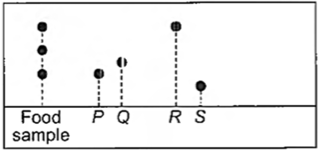
The components not present in food sample are
a) Q and R
b) P and Q
c) P and R
d) Q and S
View AnswerAns. d) Q and S
16. Which of the following is soil borne disease?
a) Leaf spot of rice
b) Red rot of sugarcane
c) Smut of bajra
d) Rust of wheat
View AnswerAns. c) Smut of bajra
17. Assertion (A): A tiger can accelerate from rest at the rate of 4 m/s2.
Reason (R): The velocity attained by it in 10s is 40 m/s.
a) Both A and R are true and R is the correct explanation of A.
b) Both A and R are true but R is not the correct explanation of A.
c) A is true but R is false.
d) A is false but R is true.
View AnswerAns. a) Both A and R are true and R is the correct explanation of A.
18. Assertion (A): Gaseous state of ammonia is not regarded as vapours.
Reason (R): As the volume of a substance increases, its density increases.
a) Both A and R are true and R is the correct explanation of A.
b) Both A and R are true but R is not the correct explanation of A.
c) A is true but R is false.
d) A is false but R is true.
View AnswerAns. b) Both A and R are true but R is not the correct explanation of A.
19. Assertion (A): Cells of cork or bark are dead, acts as a protective covering.
Reason (R): In leguminous plants, the root nodules harbor nitrogen-fixing bacteria which convert atmospheric nitrogen into nitrates.
a) Both A and R are true and R is the correct explanation of A.
b) Both A and R are true but R is not the correct explanation of A.
c) A is true but R is false.
d) A is false but R is true.
View AnswerAns. b) Both A and R are true but R is not the correct explanation of A.
20. Assertion (A): An atom contains a positively charged center called the nucleus of the atom.
Reason (R): The nucleus of an atom is 10,000 times bigger than the atom.
a) Both A and R are true and R is the correct explanation of A.
b) Both A and R are true but R is not the correct explanation of A.
c) A is true but R is false.
d) A is false but R is true.
View AnswerAns. c) A is true but R is false.
21. Why an egg sinks in fresh water but floats in a strong solution of salt?
View AnswerAns. When salt is mixed with water it increases the density of water and, hence, its density becomes greater than that of the density of egg which now floats in it.
OR
Why cutting instruments are sharpened?
View AnswerAns. All cutting instruments such as blades, axes etc. are sharpened so that the area of cross section decreases and hence pressure exerted by them increases. Thus they can easily penetrate a given surface.
22. Why are some substances found in the solid state, some in the liquid state and others in the gaseous state?
View AnswerAns. It all depends upon the amount of kinetic energy available with the constituent particles which determines their speed and the attractive forces existing between them.
1) If the constituent particles have sufficiently more kinetic energy, and they move so fast that they are not able to remain close to each other. Then the substance is in gaseous state.
2) If they are moving slowly enough then the force between the constituent particles have a chance to pull them together and the substance then exists in the form of a liquid.
3) If the constituent particles are moving so slowly that the forces of attraction hold them rigidly together, then substance exist in the form of a solid.
The important fact to keep in mind is that, ‘the higher the temperature, the faster the constituent particles move’. Due to this reason, solids melt as the temperature increases and vapourises at yet higher temperatures. The exact temperature at which a change takes place depends on the strength of the force between the molecules.
23. Does sound follow the same laws of reflection as light does? Explain.
View AnswerAns. Yes. Sound follows the same laws of reflection as light does. We can say that because here the directions in which the sound is incident and is reflected make equal angles with the normal to the reflecting surface at the point of incidence, and the three are in the same plane.
24. Explain why should we wear cotton clothes in summer.
View AnswerAns. During summer, we perspire more because of the mechanism of our body which keeps us cool. When evaporation takes place then sweat particles gain energy from body surface and change into vapour. The heat energy equal to the latent heat of vaporisation is absorbed from the body leaving the body cool. Cotton, being a good absorber of water helps in absorbing the sweat and exposing it to the atmosphere for easy evaporation. On the other hand, synthetic clothes (made of nylon, polyester, etc.) do not absorb much of sweat and therefore, they cannot keep our body cool in summer.
25. In the oil tankers some space is left at the top while filling them. Explain.
View AnswerAns. When the standing tanker suddenly picks up speed, the oil in it on account of inertia of rest tends to continue in its state of rest. Thus, in a way oil is left behind and, hence, exerts very large force on its rear wall. Conversely, when the moving tanker suddenly stops, the oil in it continues moving forward and, hence exerts a very large force on the front wall. These forces can crack the walls of the oil tanker. Therefore, to avoid such a mis-hap, some space is left at the top of the tanker for the free movement of oil.
OR
Explain why some of the leaves may fall from a tree, if we vigorously shake its branch.
View AnswerAns. When the branch is, suddenly set in motion, the leaves attached to it tend to continue in their state of rest, on account of inertia of motion. Thus a lot of strain acts on the junction of the leaves and the branches. Due to this strain the weakly held leaves are left behind and, hence fall off the branch.
26. Nucleus of an atom has positive charge on it. Establish.
View AnswerAns. This can be established on the basis of Rutherford experiment. Since some alpha particles were repelled by the nucleus of the atom, it is expected to have the same charge as on alpha particles. Therefore, nucleus of an atom has positive charge. The nucleus of an atom contains two things: Protons and neutrons. Because neutrons have no charge and protons have positive charge, the overall charge of the nucleus is positive.
Section C
i. How will you determine the depth of a sea using echo ranging in SONAR method?
View AnswerAns. The full name of SONAR is Sound Navigation and Ranging. Sonar is based on the principle of reflection of sound wave. Powerful pulses of ultrasound are sent out at regular intervals from a transmitter mounted on a ship. When these pulses are intercepted by submerged objects, they get reflected. The reflected sound or echo is detected by an underwater receiver, which is also mounted on the ship. If speed of ultrasound be v and t is the elapsed time between the transmission and the reception of the ultrasound signal, the depth of the submerged object underwater is

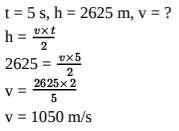
ii. A SONAR device on a submarine sends out a signal and receives an echo 5s later. Calculate the speed of sound in water if the distance of the object from the submarine in 2625 m.
View AnswerAns.
28.
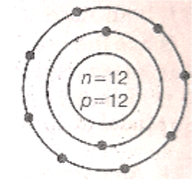
i. Identify the ion from the given figure.
View AnswerAns. Mg2+ ion is mentioned in the given figure.
ii. Write the electronic configuration of the ion and atom mentioned in the figure.
View AnswerAns. The electronic configuration of Mg2+ ion = 2, 8 and that of 12Mg atom = 2, 8, 2
iii. How do we get the number of protons as 12?
View AnswerAns. Number of protons in Mg atom = 2 + 8 + 2 = 12
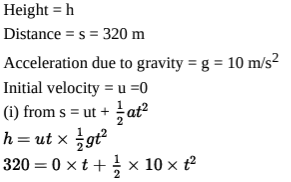
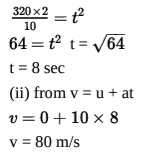
29. A body is dropped from a height of 320 m. The acceleration due to the gravity is 10 m/s2.
(a) How long does it take to reach the ground?
(b) What is the velocity with which it will strike the ground?
View AnswerAns.
OR
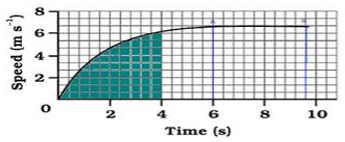
The speed-time graph for a car is shown is Fig.
Ans.
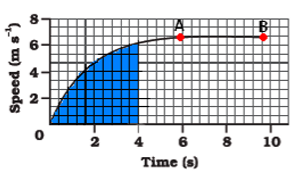
a. Find how far does the car travel in the first 4 seconds? Shade the area on the graph that represents the distance travelled by the car during the period.
View AnswerAns. Distance travelled by car in the 4 second
The area under the slope of the speed – time graph gives the distance travelled by an object. In the given graph
56 full squares and 12 half squares come under the area slope for the time of 4 seconds.
Total number of squares = 56 + 12/2 = 62 squares
The total area of the squares will give the distance travelled by car in 4 seconds. on the time axis, 5 squares = 2 seconds, therefore 1 square = 2/5 seconds on speed axis there are 3 squares = 2 m/s
therefore, area of one square = 2/5 s x 2/3 s = 4/15 m
so area of 62 squares = 4/15m x 62 = 248/15m = 16.53 m
Hence the car travels 16.53 m in the first 4 seconds
b. Which part of the graph represents uniform motion of the car?
View AnswerAns. The straight line part of graph, from point A to point B represents a uniform motion of car.
30. A boy is moving on a straight road against a frictional force of 5 N. After travelling a distance of 1.5 km he forgot the correct path at a roundabout (Fig.) of radius 100 m. However, he moves on the circular path for one and half cycle and then he moves forward upto 2.0 km. Calculate the work done by him.
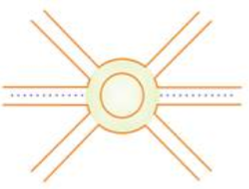
Ans. Displacement = 1500 m + 200 m + 2000 m = 3700 m Work done = Force × displacement = 5 N × 3700 m = 18500 J (Note: We do not need to calculate the circumference because we need to take displacement and not distance because displacement is change of position not distance covered by the object)
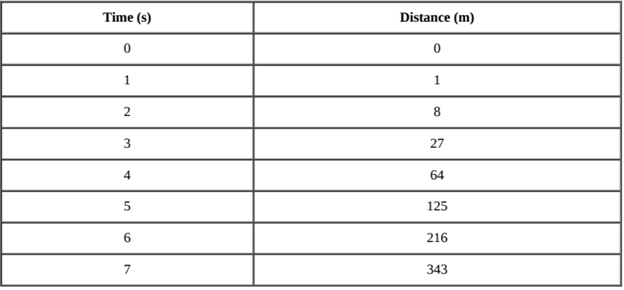
31. The following is the distance-time table of an object in motion:
Ans.
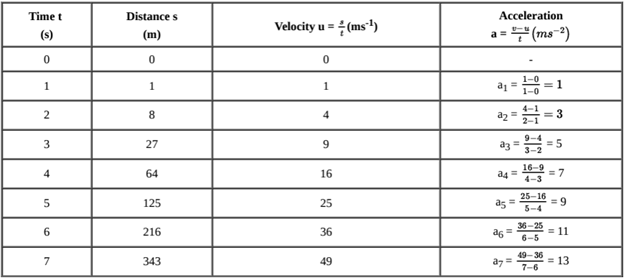
a. What conclusion can you draw about the acceleration? Is it constant, increasing, decreasing, or zero?
View AnswerAns. There is an unequal change of distance in equal interval of time. Thus, the given object is having a non-uniform motion. From the above table, it is clear that the acceleration is not constant and increase with time.
b. What do you infer about the forces acting on the object?
View AnswerAns. The object is in accelerated condition. According to Newton’s second law of motion, the force acting on an object is directly proportional to the acceleration produced in the object. So, we can say that an unbalanced force is acting on the object.
32. Differentiate between diffusion and osmosis. What is its importance?
View AnswerAns.
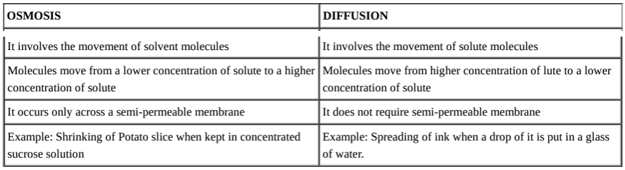
Importance – diffusion and osmosis are important for the transport of substances across the cell membrane.
OR
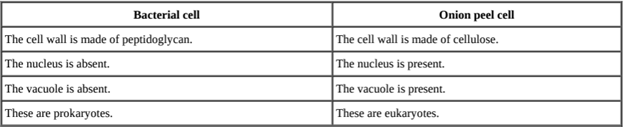
How is a bacterial cell different from an onion peel cell?
View AnswerAns.
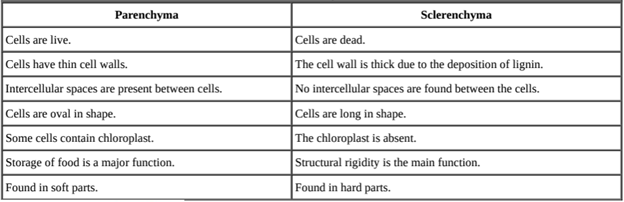
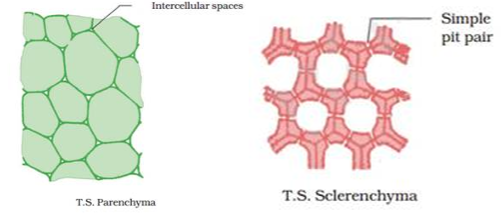
33. Differentiate between sclerenchyma and parenchyma tissues. Draw a well-labeled diagram.
View AnswerAns.
Section D
34. i. A steel needle sinks in water but a steel ship floats. Explain, how?
View AnswerAns. Ship displaces more water than needle as the volume of the ship is more than that of the needle. Since upthrust depends on the volume of the object (U= Vdg), so more the volume of the object, more upthrust act on it and object floats.
ii. Why do you prefer a broad and thick handle of your suitcase?
View AnswerAns. Since, pressure act on the body is inversely proportional to the surface area of contact, i.e.

It means that more the area of contact, less pressure will act on the body. As the broad and the thick handle of our suitcase has a large area, due to which less pressure acts on our hand and it is very easy to take from one place to another.
OR
i. A cube of side 5 cm is immersed in water and then in saturated salt solution. In which case, will it experience a greater buoyant force? If each side of the cube is reduced to 4 cm and then immersed in water, what will be the effect on the buoyant force experienced by the cube as compared to the first case for water. Give the reason for each case.
View AnswerAns. The cube will experience a greater buoyant force in saturated salt solution than in water because density of saturated salt solution is more than the density of water. If each side of the cube is reduced to 4 cm, it will result in reduction in volume of the cube. Hence, the buoyant force experienced by it will reduce in water.
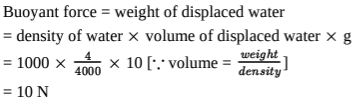
ii. A ball weight 4 kg of density 4000 kg m-3is completely immersed in water of density 103kg m-3. Find the force of buoyancy on it. (Given g = 10 ms-2.)
View AnswerAns.
35. Write the main functions of atleast ten cell components.
View AnswerAns. The ten cell components are:
i. Plasma membrane: It acts as a semipermeable membrane and allows only selective substances to pass through it.
ii. Chromosomes: To carry hereditary characters of an organism from one generation to another.
iii. Lysosomes: Breakdown of unwanted macromolecules is the main function of these organelles.
iv. Ribosomes: These help in protein synthesis.
v. Nucleus: Control centre of the cell. It contains cellular DNA (genetic information) in the form of genes.
vi. Mitochondria: The main function of mitochondria in aerobic cells is the production of energy by the synthesis of ATP.
vii. Nucleolus: Biosynthesis of ribosomal RNA (rRNA) and acts as a platform for protein synthesis.
viii. Cell wall: It provides protection and rigidity to the plant cell.
ix. Chloroplasts: These are the sites of photosynthesis within plant cells.
x. Endoplasmic reticulum: Serves as channels for transport of materials.
OR
Differentiate between
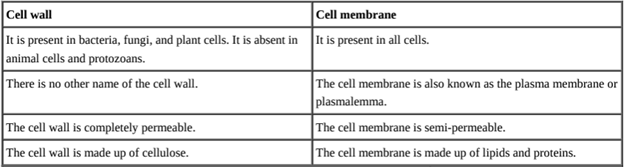
i. Cell wall and cell membrane.
View AnswerAns.
ii. Nuclear region of a bacterial cell and nuclear region of an animal cell.
View AnswerAns.

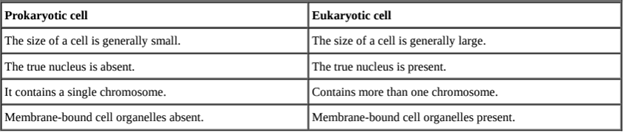
iii. Prokaryotic cell & eukaryotic cell.
View AnswerAns.
36. Classify each of the following as a physical or a chemical change. Give reasons.
i. Drying of a shirt in the sun.
View AnswerAns. It is a physical change because moisture in the shirt is converted from its liquid state to gaseous state because of the heat of the Sun.
ii. Rising of hot air over a radiator.
View AnswerAns. It is a physical change because water in the radiator is converted from a liquid state to gaseous state.
iii. Burning of kerosene in a lantern.
View AnswerAns. It is a chemical change because combustion of kerosene occurs and new products are formed.
iv. Change in the colour of black tea on adding lemon juice to it.
View AnswerAns. It is a chemical change because there is a reaction between citric acid present in lemon and the compounds of the tea resulting in the formation of new products.
v. Churning of milk cream to get butter.
View AnswerAns. It is a physical change because the cream suspended in milk is separated by churning (centrifugation).
Section E
Read the following text carefully and answer the questions that follow:
The covering or protective tissues in the animal body are epithelial tissues. Epithelium covers most organs and cavities within the body. It also forms a barrier to keep different body systems separate. Epithelial tissue cells are tightly packed and form a continuous sheet. The skin, which protects the body, is also made of squamous epithelium. Skin epithelial cells are arranged in many layers to prevent wear and tear. This columnar epithelium facilitates movement across the epithelial barrier. In the respiratory tract, the columnar epithelial tissue also has cilia, which are hair-like projections on the outer surfaces of epithelial cells. Cuboidal epithelium forms the lining of kidney tubules.
i. Identify the type of epithelial tissue shown in the following figure.
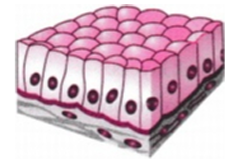
Ans. Columnar.
ii. Which cell is present in the inner lining of the intestine?
View AnswerAns. columnar epithelial.
iii. Is excretion is the main function of the cuboidal epithelium?
View AnswerAns. No, providing mechanical support is the main function of the cuboidal epithelium.
OR
Sometimes a portion of the epithelial tissue folds inward, and a multicellular gland is formed which is called a?
View AnswerAns. Glandular epithelium.
38. Read the following text carefully and answer the questions that follow:
Crop Season: Different crops require different climatic conditions like temperature, moisture and photoperiods to grow well and complete their life cycle.
The Indian cropping season is classified into two main seasons- (i) Kharif and (ii) Rabi based on the monsoon.
The characteristics of these two main crop seasons are:

i. Mention the various cropping seasons in India.
View AnswerAns. The various cropping seasons in India are Rabi crop, Kharif crop and Zaid crop.
ii. Differentiate between Rabi and Kharif crops.
View AnswerAns. Rabi crops are sown during the winter season which requires less water.
Kharif crop is sown during the summer/rainy season which requires abundant water.
iii. If there is low rainfall in a village throughout the year, what measures will you suggest to the farmers for better cropping?
View AnswerAns. Farmers are suggested to grow drought-resistant crops that can mature early. Along with this farmers are advised to use manure for their fields as it increases the water-holding capacity of the soil.
OR
What is zaid crop? Give example.
View AnswerAns. There is a short season between Kharif and Rabi season in the months of March to July. The crops that grow in this season are Zaid crops. These crops are grown on irrigated lands and do not have to wait for monsoons. Some examples of Zaid types of crops are pumpkin, cucumber, and bitter gourd.
39. Read the following text carefully and answer the questions that follow:
Homogeneous mixtures are regarded as solutions or true solutions. Heterogeneous mixtures are of two types. These are suspensions and colloidal solutions. These differ in the size of the particles responsible for the difference in their properties. In a suspension, the particle size is more than 10-5 cm whereas in a colloidal solution, it ranges between 10-5 cm to 10-7 cm. The two phases which constitute colloidal solutions, are dispersed phase and dispersion medium. Based upon their nature, the colloidal solutions are classified into eight types. The mixture of the non-reacting gases is always homogeneous irrespective of their nature. Therefore, it is not a colloidal solution.
i. Scattering of light occurs when a beam of light is passed through Blood. Why?
View AnswerAns. Since blood is a colloid, so tyndall effect is observed when a beam of light is passed through it since the dispersed particles of a colloid are large, deflect light.
ii. What is Tyndall effect?
View AnswerAns. The phenomenon by which the colloidal particles scatter light is called Tyndall effect. If light is passed through a colloid the light is scattered by the larger colloidal particles and the, beam becomes visible.
iii. What is called colloidal solution?
View AnswerAns. Colloidal solutions area mixture in which the substances are regularly suspended in a fluid. A colloid is a very tiny and small material that is spread out uniformly all through another substance.
OR
Give an example of colloidal solution and identified their dispersed phase and dispersion medium?
View AnswerAns. Fog: Liquid (water drops) acts as dispersed phase and gas (air) as the dispersion medium.