SOCIOLOGY (039)
Time: 3 Hours Max. Marks: 80
General Instructions:
1. The question paper is divided into four sections.
2. There are 35 questions in all. All questions are compulsory.
3. Section A includes question No. 1-16. These are MCQ type questions. As per the question, there can be one answer.
4. Section B includes question No.17-25. These are very short answer type questions carrying 2 marks each. Answer to each question should not exceed 30 words.
5. Section C includes question No. 26-32. They are short answer type questions carrying 4 marks each. Answer to each question should not exceed 80 words.
6. Section D includes question No. 33-35. They are long answer type questions carrying 6 marks each. Answer to each question should not exceed 200 words each.
7. Question no. 33 is to be answered with the help of the given graphics.
SECTION A
1. Assertion (A) : According to Census of India 2011, still more people are living in rural areas, but the population of urban areas has increased.
Reason (R) : About 68.8% population lives in rural areas and 31.2% people live in urban areas.
Codes
(a) Both (A) and (R) are true and (R) is the correct explanation of (A).
(b) Both (A) and (R) are true, but R is not the correct explanation of (A).
(c) (A) is true, but (R) is false.
(d) (A) is false, but (R) is true.
View AnswerAns. (b) Both (A) and (R) are true, but R is not the correct explanation of (A).
2. Assertion (A) : Protests by Scheduled castes against the practice of untouchability and atrocities have increased.
Reason (R) : Their action have stirred the government machinery to enforce law and order strictly.
Codes
(a) Both (A) and (R) are true and (R) is the correct explanation of (A)
(b) Both (A) and (R) are true, but (R) is not the correct explanation of (A)
(c) (A) is true, but (R) is false
(d) (A) is false, but (R) is true
View AnswerAns. (d) (A) is false, but (R) is true
3. In the context of rural-urban migration, consider the following progressions regarding migration rates and infrastructure development:
I. Migration increases in geometric progression as 1,2,4,8,16, while infrastructure develops in arithmetic progression as 1,2,3,4,5.
II. Migration increases in arithmetic progression as 1,2,3,4,5, while infrastructure develops in geometric progression as 1,2,4,8,16.
III. Migration increases in geometric progression as 2,4,8,16,32, while infrastructure develops in arithmetic progression as 2,4,6,8,10.
IV. Migration increases in arithmetic progression as 2,4,6,8,10, while infrastructure develops in geometric progression as 2,4,8,16,32.
(a) I. and III.
(b) II. and IV.
(c) I., II., and IV.
(d) I. and IV.
View AnswerAns. (a) I. and III.
4. Assertion (A) : Traditionally, a lower caste adopted the life style of the dominant caste in the process of Sanskritisation.
Reason (R) : Adaption of the life style of the dominant caste usually symbolised a caste of upward mobility within the caste system.
Codes
(a) Both (A) and (R) are true and (R) is the correct explanation of (A)
(b) Both (A) and (R) are true, but (R) is not the correct explanation of (A)
(c) (A) is true, but (R) is false
(d) (A) is false, but (R) is true
View AnswerAns. (b) Both (A) and (R) are true, but (R) is not the correct explanation of (A)
5. Which among the following sentences is not correct about the social inequality and exclusion?
(a) Social inequality and exclusion are social because they are not about individuals but about groups.
(b) They are social in the sense that they are not economic, although there is usually a strong link between social and economic inequality.
(c) Social inequalities are systematic and structured, while exclusion is a definite pattern to social inequalities.
(d) None of the above
View AnswerAns. (d) None of the above
Read the passage given below:
The Dalit literature has been instrumental in supporting Dalit movements by offering a platform for the voices of marginalized communities. It articulates the lived experiences and perceptions of discrimination faced by Dalits, exposing these realities to the wider public. By fostering a sense of shared identity, Dalit literature has united the community to collectively address and challenge societal discrimination.
6. Which of the following statements is incorrect?
(a) Dalit literature solely focuses on the experiences of upper castes.
(b) Dalit literature brings the experiences and perceptions of Dalits to public knowledge.
(c) It fosters a sense of unity among Dalits by highlighting their common struggles.
(d) Dalit literature supports the Dalit movement by making their experiences widely understood.
View AnswerAns. (a) Dalit literature solely focuses on the experiences of upper castes.
7. How does Dalit literature contribute to Dalit movements?
I. It exposes the discrimination faced by Dalits to the public.
II. It helps in creating a sense of unity and community among Dalits.
III. It discourages Dalits from participating in collective action.
IV. It provides an essential platform for expressing the perspectives of Dalits.
(a) I. and III. only
(b) II. and IV. only
(c) I., II., and IV. only
(d) I., II., III., and IV
View AnswerAns. (c) I., II., and IV. only
8. Assertion (A) : Social changes as changes in human interactions and relationships that transform cultural and social institution.
Reason (R) : Social changes occur over time and often have prefound and long term consequence for society.
Codes
(a) Both (A) and (R) are true and (R) is the correct explanation of (A)
(b) Both (A). and (R) are true, but (R) is not the correct explanation of (A)
(c) (A) is true, but (R) is false
(d) (A) is false, but (R) is true
View AnswerAns. (a) Both (A) and (R) are true and (R) is the correct explanation of (A)
Read the passage given below:
Human populations often grow at a faster rate than the resources needed to sustain them, particularly agricultural production. This disparity has led to the argument that poverty and scarcity are inevitable outcomes of unchecked population growth. However, advancements in technology and agricultural practices have challenged this view by demonstrating the potential for increasing productivity.
9. Which of the following statements is incorrect?
(a) Population growth can outpace the growth of agricultural production.
(b) Human poverty is inevitable due to rapid population growth.
(c) Advancements in agriculture can help overcome resource shortages.
(d) Technology plays no role in addressing the challenges of population growth.
View AnswerAns. (d) Technology plays no role in addressing the challenges of population growth.
10. What are the implications of population growth outpacing resource growth?
I. It leads to poverty and resource scarcity.
II. Technological advancements can mitigate these challenges.
III. Agricultural production cannot grow faster than population growth.
IV. Overpopulation has no connection with poverty.
(a) I. and III. only
(b) I., II., and III. only
(c) II., III., and IV. only
(d) I., II., and IV. only
View AnswerAns. (b) I., II., and III. only
11. A nation is a peculiar community that is easy to describe but hard to define. Which of the following is a correct statement about nation ?
(a) It is a body that claims monopoly of legitimate force.
(b) It is a political-legal institution.
(c) Its ultimate source of legitimacy are the people who constitute it.
(d) It claims control over a geographical territory.
View AnswerAns. (c) Its ultimate source of legitimacy are the people who constitute it.
12. Which of the following is the major issue that challenges the diversity of India?
(a) Regionalism, which emphasizes loyalty to one’s own region over the nation as a whole.
(b) Communalism, which fosters divisions based on religious identities and often leads to conflicts
(c) Casteism, which perpetuates discrimination and inequality based on the caste system
(d) All of these issues collectively threaten the unity and diversity of India
View AnswerAns. (d) All of these issues collectively threaten the unity and diversity of India
13. Assertion (A) : M.N. Srinivas is known for his contributions to the study of the caste system and for coining terms like ‘Sanskritisation’ and ‘dominant caste.’
Reason (R) : His work highlighted the dynamic nature of caste in Indian society and its role in social mobility and power structures.
(a) Both (A) and (R) are true, and (R) is the correct explanation of (A).
(b) Both (A) and (R) are true, but (R) is not the correct explanation of (A).
(c) (A) is true, but (R) is false.
(d) (A) is false, but (R) is true.
View AnswerAns. (a) Both (A) and (R) are true, and (R) is the correct explanation of (A).
14. Assertion (A) : Industrialisation refers to the emergence of machine production using inanimate power sources like steam and electricity.
Reason (R) : It marked a shift from manual production to mechanised systems, transforming economies and societies globally.
(a) Both (A) and (R) are true, and (R) is the correct explanation of (A).
(b) Both (A) and (R) are true, but (R) is not the correct explanation of (A).
(c) (A) is true, but (R) is false.
(d) (A) is false, but (R) is true.
View AnswerAns. (a) Both (A) and (R) are true, and (R) is the correct explanation of (A).
15. An industry defined by the investment of capital mode into it is known as:
(a) Large-scale industry, which requires significant capital investment and typically involves extensive infrastructure and machinery.
(b) Medium-scale industry, which requires moderate capital investment and operates on a scale smaller than large industries but larger than small ones.
(c) Small-scale industry, which operates with limited capital investment and smaller production facilities, often focused on localized markets.
(d) All of these, as industries of all scales are categorized based on the level of capital investment involved.
View AnswerAns. (d) All of these, as industries of all scales are categorized based on the level of capital investment involved.
16. Put the following statements in the correct order:
I. Industrialization led to the rise of factories and urban centres.
II. Traditional rural communities started to disintegrate.
III. Large-scale migration occurred as people moved to cities for work.
IV. Social relationships became more impersonal and formal in urban settings.
(a) II., I., III., IV.
(b) I., II., III., IV.
(c) IV., III., I., II.
(d) III., II., IV., I.
View AnswerAns. (b) I., II., III., IV.
SECTION B
17. Based on the given passage, answer the following question.
Sociologists use the term social stratification to refer to a system by which categories of people in a society are ranked in a hierarchy. This hierarchy then shapes people’s identity and experiences, their relations with others as well as their access to resources and opportunities. What is the key principles of social stratification ?
View AnswerAns. The key principles of social stratification are as follows
(i) Social stratification is not just a function for the individual difference but is a characteristic of a society.
(ii) Social stratification is continuing from generation to generation.
(iii) Social stratification is supported by a prototype of belief or ideology.
OR
What are the changes coming in caste system?
View AnswerAns. Many changes came in the caste system due to Western education, industrialisation, urbanisation, means of communication, etc. Almost all the restrictions of the caste system are coming improved to an end. Inter-caste marriages are increasing, the position of lower caste has been improved, steps have been taken against all types of discrimination, and problems regarding occupation is no more in the society.
18. There is a difference between the concepts of ‘Nation’ and ‘Nation state’ in context of cultural diversity. Explain.
View AnswerAns. The main difference between ‘Nation’ and ‘Nation state’ is that a ‘Nation’ is a large body of people united by a common origin, history, culture, ethnicity or language while Nation state’ is a state where people with a common identity live inside a country with firm borders and a single government.
19. What are the negative impacts of industrialisation on labourers?
View AnswerAns. Negative impacts of industrialisation on labourers are as follows
(i) Very few people are given work in more mechanised industries. Whatever the number of
people works in it, have to work like machines which alienate them form their work.
(ii) Very less time for rest is given to workers during their working hour. That is why, they become frustrated when they reach the age of 40 and take voluntary retirement.
20. Workers’ strikes during British rule in India were significant in the struggle against colonial exploitation. These events reflected the growing discontent among industrial workers due to poor wages, long hours, and inhumane working conditions. Highlight the events of Worker’s strike during British rule in India.
View AnswerAns. Some popular events of worker’s strike during the British rule in India as follows
(i) Tea plantations in Assam were established as early as 1839. In the early stages of colonialism, labour was very cheap, as the colonial government did not regulate either wages or working conditions. However, later trade unions emerged and then workers started to protest. Their actions were more spontaneous than sustained.
(ii) In September and October 1917, there were around 30 recorded strikes. Jute workers in Calcutta struck work. In Madras, the workers of Buchingham and Carnatic Mills (Binny’s) struck work for increased wages. Textile workers in Ahmedabad struck work for increase in wages by 50 per cent.
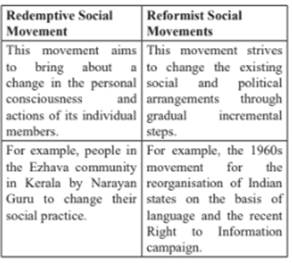
21. What are the fundamental differences between the Redemptive and Reformist Social movements?
View AnswerAns. There are fundamental differences between the Redemptive and Reformist Social movements which are as follows
22. The sex ratio is a demographic measure reflecting the proportion of females to males in a given population. In societies with a declining sex ratio, social structures are impacted, and certain demographic challenges may emerge. What is meant by the ‘Sex ratio’? State any one implication of a declining sex ratio.
View AnswerAns. Sex ratio refers to the number of females per 1000 males in a given area at a specified time period.
An implication of a declining sex ratio is severe neglect of girls in infancy, sex-specific abortions that prevent girl babies from being born and female infanticide.
23. Land ceiling aimed to limit land ownership and promote fair distribution of resources. It sought to empower marginalized communities but faced challenges like loopholes and resistance from large landowners. What do you mean by land ceiling? What are the different reforms it brought about in India?
View AnswerAns. Land ceiling is a concept where an individual should possess cultivable land according to a prescribed limit. The different reforms that brought in India are as follows
(i) Redistribution of cultivable land.
(ii) Ceiling of the upper limit of land holdings.
24. Dalit literature highlighted marginalization and social injustices, raising awareness and inspiring movements for equality. How did Dalit literature helped with the caste based Dalit movements?
View AnswerAns. The Dalit literature played an essential role in supporting the Dalit movements by providing them the necessary support.
Through the Dalit literature, the perspective of the Dalits or the lower castes was exposed deep rooted in their own experience and perceptions.
This way, the viewpoint of Dalits about the discrimination they experience became public knowledge.
The Dalit literature also helped to grow the community feeling among the Dalits and they could come together to fight for the same cause.
25. After 1990, the Government of India has followed a policy of liberalisation. Under this policy, the private companies, especially foreign firms, were encouraged to invest in sectors which were earlier reserved only for the government, including telecom, civil aviation, power, etc. How has liberalisation affected employment patterns in India?
View AnswerAns. The Indian Government has followed a policy of liberalisation since 1990. The liberalisation has affected employment in the following ways
(i) Due to liberalisation foreign products are now easily available in Indian market and shops. It increased the employment opportunities in industries and MNC’s.
(ii) Many Indian companies have been taken over by multinationals. At the same time some Indian companies are becoming multinational companies.
OR
Highlight any two features of an organised sector.
View AnswerAns. The two features of organised sector are as follows
(i) An organised sector is a type of sector which is subject to regulations that every employee must follow.
(ii) The organisations in organised sector are registered with the government. This ensures that the employees get proper salaries and other benefits.
SECTION C
26. Dalit literature highlighted marginalization and social injustices, raising awareness and inspiring movements for equality. Discuss some of the features of the Zamindari system during British rule in India.
View AnswerAns. The main features of the Zamindari system during British rule were as follows
(i) Under the Zamindari system, an agreement was signed between the British officers and the Zamindars. Under this agreement, the Zamindars were provided with Zamindari rights of the land.
(ii) Rajas and Taluqdars were recognised as zamindars and became responsible for collecting revenue from peasants and paying to the company. In addition to it, revenue demand was permanently fixed.
(iii) This system was majorly considered to be exploitative in nature and the farmers, who were landless suffered at the hands of the zamindars that used to extort lot of money from these farmers.
(iv) Zamindari system was introduced by Comwallis in 1793 through the Permanent Settlement Act during the British rule in India. It was introduced in the provinces.of Bengal, Bihar, Odisha and Varanasi. It is also known as ‘Permanent Settlement System’.
OR
What were the major provisions of the Land Ceiling Act? Does the act have any loopholes in it’s implementation? Mention them.
View AnswerAns. The major provisions of the Land Ceiling Act were as follows
(i) Land Ceiling Act imposed upper limit on the amount of land that can be owned by a particular family.
(ii) Possession of surplus land (above the ceiling limit) held by each household, and redistribute it to landless families.
There were many loopholes and other strategies through which most landowners were able to escape from having their surplus land taken over by the state. The loopholes found in the implementation of the Land Ceiling Act were as follows
(i) In most cases landowners managed to divide the land among relatives and others, including servants, in so-called benamic transfers.
(ii) In some places, some rich farmers actually divorced their wives (but continued to live with them) in order to avoid the provisions of Land Ceiling Act, which allowed a separate share for unmarried women but not for wives.
27. Commitment to minority protection often requires the state to address diverse and sometimes conflicting demands. Balancing these with majority interests can strain governance. Politicization of minority issues further complicates this responsibility. How can commitment to the protection of minorities also be a challenge to the state?
View AnswerAns. Commitment to the protection of minorities can be a challenge to the state because the Constitution of India declared the state as a secular state. However, in practice, minorities are often hurt by the actions of the state. There are many religious minorities which may be better economically but a disadvantaged group in the cultural sense because of their small numbers.
It is important to provide them with protection due to the following reasons
(i) Religious and cultural minority groups need protection because of the demographic dominance of the majority.
(ii) They should be given special consideration so that they are not considered a minority in the political sphere.
(iii) These groups are vulnerable and can face major risk by the majority community. They can use their power to suppress their religion and cultural Institution and eventually forcing them to completely abandon their identity.
28. Sanskritisation involves adopting upper-caste practices to seek social mobility. While it provides limited benefits, it often reinforces caste hierarchies and excludes marginalized groups, sustaining discrimination. Process of Sanskritisation encourages inequalities and discrimination. Explain with example.
View AnswerAns. Process of Sanskritisation encourages inequalities and discrimination in society. It has been criticised for enaggerating social mobility or the scope of ‘lower castes’ to move up the social ladder. This has lead to no structural change but only positional change of some individuals. The following are some examples
(i) The ideology of sanskritisation accepts the ways of the upper caste as superior and that of the lower caste as inferior. Therefore, the desire to initate the ‘upper caste’ is seen as natural and desirable.
(ii) Process that is gendered though progressive for men, upper caste practices like Purdah system, low age of marriage, dowry in place of bride price are regressive as far as women are concerned.
(iii) Sanskritisation results in the adoption of upper caste rites and rituals it leads to practices of secluding girls and women adopting dowry practices instead of bride-price.
OR
Efforts by social reformers focused on addressing societal injustices faced by women. By raising awareness and advocating for systemic change, they worked to challenge traditional norms and promote gender equality. Explain the role of social reformers in uplifting the status of women in India.
View AnswerAns. Social reformers played a significant role in upliftment of the women issues in Indian history. For example, issues related to practice of sati system, child marriage and widow remarriage were taken up by the reformers. Female education was promoted by the social reformers and new ideas of liberalism and freedom also brought new ideas of homemaking and marriage.
Jyotiba Phule the reformer opened the first school for women in Pune. Another reformer, Jahanara Shah at the All India Muslim Ladies Conference proposed a resolution against the evils of polygamy in Islam.
Thus, social reformers tried to bring changes in the social practices that discriminated against women.
29. Mechanisation enhances efficiency by replacing manual labor with machines, which often leads to reduced workforce requirements. This shift significantly impacts employment opportunities in various industries. The more mechanised an industry gets, the fewer people are employed. Explain with a suitable example.
View AnswerAns. If Industries become more mechanised, automated, and digitised, fewer people are required to perform the same amount of work. This can have a significant impact on employment levels and the labour market.
One example of this can be seen in the manufacturing industry. With the advent of industrial automation and robotics, many factories and assembly lines have become highly automated. This means that machines and robots perform many of the tasks that were previously done by human workers. For example, in car manufacturing plants, robots can be programmed to perform tasks such as welding, painting, and assembly, which were previously done by human workers.
As a result, the number of workers required to operate a factory or assembly line has decreased significantly. In some cases, entire production lines can be run with just a handful of workers overseeing the operation of the machines. While this has increased productivity and efficiency, it has also led to job losses in the manufacturing sector.
30. What was the opinion of Rabindranath Tagore on the evils of exclusive nationalism in context of Indian society? Explain.
View AnswerAns. The opinion of Rabindranath Tagore on the evils of exclusive nationalism in context of Indian society was deeply critical to western notion of nationalism. He holds that a nation is a political and economic union of people who are organised for mechanical purpose. He specifies nation as an end in itself and not a means to an end. He wrote his important literary work ‘On Nationalism’ which was first published in 1917. He believed that India does not need to be insecure, and that it does not have to protect itself against any force from outside. He was not blind to accept and believe only in the nation’s heritage and past. He reciprocated the western culture as he believed that it would also be helpful in India’s growth. In this writing, he aims to convince his audience that India’s many problems are social, rather than political.
In fact, he goes one stage further and states that the fundamental problems in all nations are social. Tagore’s perception of nationalism has mainly relied on ancient Indian philosophy, where the world was accepted as a single nest. In this way, Tagore was striving to dissociate himself from the general belief of nationalism and trying to associate it with ideas such as peace, harmony and welfare.
31. How does the ‘National development’ affect tribal communities in India? Justify your answer by giving examples.
View AnswerAns. National development severely affected the tribal communities in India through several development policies and projects. National development is referred to as the building of large dams, factories and mines across the country. As the tribal areas were located in mineral rich and forest covered parts of the country, tribal communities have paid a disproportionate price for the development of the rest of Indian society.
There are some examples which highlight how national development affected the tribal communities in India, which are as follows
(i) National development in the post-independent era, focused on the building of large dams, factories and mines etc. As the tribal areas were rich in minerals, they paid a heavy price for the development activities, which benefitted the mainstream at the expense of the tribes.
(ii) The idea of private property in land, also, adversely affected the tribes. Tribes which mostly had collective community based ownership-were at a disadvantage in the new system. Example series of dams being built over the Narmada river.
(iii) Many tribal regions have experienced heavy in- migration of non-tribals. This threatens to disrupt their cultures and communities. For example, Jharkhand and Tripura.
32. Ecological movements aim to protect the environment and advocate for sustainable practices. They often emerge as responses to environmental crises, involving collective action to preserve natural resources. Explain an ecological movement with an example.
View AnswerAns. The ecological or environmental movement is a diverse scientific, social and a political movement for addressing environmental issues.
The Chipko Movement is an example of the ecological movement, started in the Himalayan foothills. When government forest contractors came to cut down the trees, villagers, including large number of women, stepped forward to hug the trees to prevent their being felled.
All of them relied on the forest to get firewood, fodder and other daily necessities. This conflict placed the livelihood needs of poor villagers against the government’s desire to generate revenues from selling timber. The economy of subsistence was pitted against the economy of profit. Along with this issue of social inequality (villagers versus a government that represented commercial, capitalist interests), the Chipko Movement also raised the issue of ecological sustainability.
In addition, the Chipko Movement also expressed the resentment of hill villagers against a distant government headquartered in the plains that seemed indifferent and hostile to their concerns. So, concerns about economy, ecology and political representation underlay the Chipko Movement.
SECTION D
33. On the basis of the bar graph, answer the following questions.
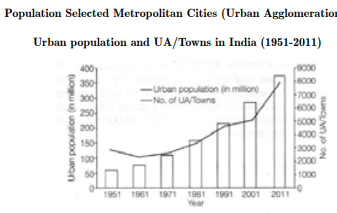
(a) In absolute terms, what is the difference in urban Indian population between 1951 and 2011?
View AnswerAns. (a) In absolute terms the difference in urban Indian population between 1951 and 2011 is between 250-350 million inhabitants. It can be seen from graph lived in urban areas.
(b) Urban areas have seen a greater growth in population than rural areas, although the rate of growth in urban areas remains nearly constant. State the main reason.
View AnswerAns. (b) Urban areas have seen a greater growth in population than rural areas, although the rate of growth in urban areas remains nearly constant. The absolute increase in population is more in urban areas than in rural areas. This is due to a sharp decline in the growth rate in rural areas, while the growth rate in urban areas remains almost the same.
(c) On the basis of bar graph, it shows a steady increase in rms of absolute numbers and the per cent share of the urban population. State them.
View AnswerAns. (c) India’s urban population has been increasing since 1951 to 2011. In 1951, 62.44 million people were living in 2,843 towns. In 2011, 377.10 million people were living in 7,935 towns. This shows a steady increase in terms of absolute numbers and the per cent share of the urban population.
34. There are direct linkages between the situation of agricultural workers and then-lack of upward socio-economic mobility. Discuss with suitable example.
View AnswerAns. The situation of agricultural workers in directly linked with their lack of upward socio-economic mobility because
(i) Indian rural society is totally dependent on agriculture. It is the only source of their livelihood. Unfortunately, it is unevenly distributed, not organised and many people of rural Society are landless.
(ii) Most of the people in villages are landless and for their livelihood they become agriculture workers. They are paid below the statutory minimum wages. Their job is not regular and employment is insecure. Mostly these agriculture workers work on daily wages.
(iii) The tenants also have lower income because they have to pay a large amount of production to the landowner.
(iv) The ownership of land or its total area determines the position of the farmers upward or downward mobility in his socio-economic system. Therefore, the agrarian society can be understood in terms of its class structure which is structured through Caste system.
(v) Indian rural society has patrilineal kinship system. According to legal system women are supposed to have an equal right of family property but actually it is simply on papers. Because of male dominance, they are deprived of their rights.
35. (a) Highlight the important key features of the Karachi Declaration held in 1931 with regards to fundamental rights in India.
View AnswerAns. (a) The Karachi Congress session which was held on 26th to 31st March, 1931 was chaired by Sardar Vallabhbhai Patel.
Some important key features of the Karachi Declaration held in 1931 with regards to fundamental rights in India were
(i) All citizens are equal before the law, irrespective of religion, caste, creed or sex.
(ii) No disability attaches to any citizen, by reason of his or her religion, caste, creed or sex, in regard to public employment, office of power or honour, and in the exercise of any trade or calling.
(iii) Woman shall have the right to vote, to represent and the right to hold public offices. (iv) The resolution on Fundamental Rights guaranteed several civil rights including free speech and free press, right to form associations, universal adult franchise.
(b) What was the resolution on National Economic Programme in Karachi session of INC?
View AnswerAns. (b) The Resolution on National Economic Programme included
(i) substantial reduction in rent and revenue in the case of landholders and peasants.
(ii) exemption from rent for uneconomic holdings.
(iii) relief from agricultural indebtedness.
(iv) control of usury.
(v) better conditions of work including a living wage, limited hours of work and protection of women workers in the industrial sector.
(vi) right to workers and peasants to form unions.
(vii) state ownership and control of key industries, mines and means of transport.