Political Science (028)
Time : 3 Hours Max. Marks : 80
General Instructions :
Read the following instructions very carefully and follow them:
1. This question paper contains 30 questions. All questions are compulsory.
2. Question paper is divided into five sections A, B, C, D and E.
3. Section A questions number 1 to 12 are Multiple Choice type questions. Each question carries 1 mark.
4. Section B questions number 13 to 18 are Short Answer type questions. Each question carries 2 marks. Write answer to each question in 50 to 60 words.
5. Section C questions number 19 to 23 are Long Answer Type-I question. Each question carries 4 marks. Write answer to each question in 100 to 120 words.
6. Section D questions number 24 to 26 are Passage, Cartoon and Map-based questions. Answer each question accordingly.
7. Section E questions number 27 to 30 are Long Answer Type-II questions. Each question carries 6 marks. Write answer to each question in 170 to 180 words.
8. There is no overall choice in the question paper. However, an internal choice has been provided in few questions. Only one of the choices in such questions has to be attempted.
9. In addition to this, note that a separate question has been provided for Visually Impaired candidates in lieu of questions having visual inputs, map etc. Such questions are to be attempted by Visually Impaired candidates only
SECTION-A
1. Resistance to globalisation has emerged in various forms across different societies. Which of the following statements is NOT correct about Resistance to Globalisation?
(A) Resistance movements often arise due to concerns over cultural homogenization.
(B) Economic inequalities resulting from globalisation can fuel resistance.
(C) Resistance to globalisation always leads to the complete rejection of global integration.
(D) Some resistance focuses on protecting local industries and jobs from global competition.
View AnswerAns. (C) Resistance to globalisation always leads to the complete rejection of global integration.
2. Assertion (A): Shock Therapy involved rapid economic liberalization in post-Soviet states.
Reason (R): Shock Therapy led to the immediate stabilization of the economies of post-Soviet states. Options:
(A) Both A and R are true, and R is the correct explanation of A.
(B) Both A and R are true, but R is not the correct explanation of A.
(C) A is true, but R is false.
(D) A is false, but R is true.
View AnswerAns. (C) A is true, but R is false.
3. Match the terms given in column ‘A’ correctly with their meaning given in column ‘B’ and choose the appropriate code as the correct answer:
Column A
1. Japan as an Emerging Power
2. South Korea as an Emerging Power
3. Alternative Centres of Power
4. Economic Rise of China
Column B
(i) A nation in East Asia experiencing rapid economic growth and increasing global influence.
(ii) Countries or regions that provide significant economic and political influence apart from traditional superpowers.
(iii) A leading Asian economy known for its technological advancements and strong industrial base.
(iv) A country in East Asia with a booming economy and significant contributions to global technology and manufacturing.
Codes:
(A) 1-(iii), 2-(iv), 3-(ii), 4-(i)
(B) 1-(ii), 2-(iii), 3-(i), 4-(iv)
(C) 1-(iv), 2-(ii), 3-(iii), 4-(i)
(D) 1-(i), 2-(iv), 3-(ii), 4-(iii)
View AnswerAns. (A) 1-(iii), 2-(iv), 3-(ii), 4-(i)
4. Given below are two statements:
Statement I: Nepal became a federal democratic republic in 2008 after abolishing its monarchy.
Statement II: The transition from monarchy to republic in Nepal occurred without any internal conflict.
In the light of the above statements, choose the correct answer from the options given below:
(A) Both Statement I and Statement II are true
(B) Both Statement I and Statement II are false
(C) Statement I is true, but Statement II is false
(D) Statement I is false, but Statement II is true
View AnswerAns. (C) Statement I is true, but Statement II is false
5. Arrange the following key UN agencies in chronological order based on their founding:
I. International Monetary Fund (IMF)
II. World Bank
III. World Trade Organization (WTO)
IV. International Labour Organization (ILO)
Choose the correct option:
(A) IV, I, II, III
(B) IV, II, I, III
(C) IV, I, III, II
(D) IV, II, III, I
View AnswerAns. (A) IV, I, II, III
6. Identify and write the Incorrect pair:
(A) Terrorism – Considered a non-traditional security threat
(B) Cybersecurity – Emerging threat in contemporary security agenda
(C) Health Epidemics – Non-traditional security issue
(D) Nuclear Proliferation – Non-traditional security threat
View AnswerAns. (D) Nuclear Proliferation – Non-traditional security threat
7. The conflict between the government and the judiciary reached a peak with which landmark case?
(A) Golaknath Case
(B) Minerva Mills Case
(C) Kesavananda Bharati Case
(D) Maneka Gandhi Case
View AnswerAns. (C) Kesavananda Bharati Case
8. What was one of the major factors contributing to the conflict in Jammu and Kashmir after its accession to India?
(A) Lack of economic resources
(B) Foreign investment issues
(C) Dispute over Article 370 and demands for autonomy
(D) Desire to join a South Asian federation
View AnswerAns. (C) Dispute over Article 370 and demands for autonomy
9. The Congress-led coalition government formed in 2004 was known as ____________.
(A) National Front
(B) National Democratic Alliance
(C) United Front
(D) United Progressive Alliance
View AnswerAns. (D) United Progressive Alliance
10. The integration of which princely state into India was successfully resolved through a public plebiscite, allowing citizens to express their preference?
(A) Hyderabad, following prolonged negotiations and military intervention
(B) Junagadh, where a plebiscite confirmed the people’s desire to join India
(C) Kashmir, which remains a disputed territory to this day
(D) Manipur, which became part of India following agreements with local leaders
View AnswerAns. (B) Junagadh, where a plebiscite confirmed the people’s desire to join India
11. The Congress was able to function as both a ruling and opposition party due to ____________.
(A) Lack of a formal opposition structure
(B) A unique coalition-like structure with internal factions
(C) Its exclusive focus on economic development
(D) The absence of other major political parties
View AnswerAns. (B) A unique coalition-like structure with internal factions
12. Which term best describes the economic system India followed immediately after independence, characterized by state-led initiatives with private sector collaboration?
(A) Socialist capitalism
(B) Mixed economy
(C) Planned liberalism
(D) Open-market socialism
View AnswerAns. (B) Mixed economy
SECTION-B
13. Describe any two objectives of Planning in India.
Ans. Two objectives of Planning in India are:
(i) To ensure optimal utilisations of scarce resources.
(ii) To bring desired socio-economic changes rapidly.
14. What were the goals on which everyone agreed on the eve of independence?
View AnswerAns. Although, there were many voices and demands during National Movement but there were two goals on which everyone agreed upon. These were
(i) Our country shall be governed by a democratic government after independence.
(ii) Government will work for the welfare of all, particularly poor and socially disadvantaged groups of society.
15. Describe any two social causes that led to Arab Spring.
View AnswerAns. Following are the two social cause that led to the Arab Spring
(i) The demand for political freedom and removal of economic inequalities.
(ii) The media and internet made the transmission of information and news throughout the world thereby spreading the movement.
16. List any two differences between the Socialist and Communist party.
View AnswerAns. The two differences are
⚫ Socialist party believes in gradual change whereas, the Communist party believes in radical and fundamental change.
⚫ Socialist party aims at improvement and reform in society while, Communist party aims at restructuring of an entire society.
17. What had been government’s approach towards the integration of Princely States?
View AnswerAns. Government’s approach towards the integration of Princely States was based on three considerations
(i) People of most of the Princely States wanted to be a part of the Indian Union.
(ii) Government was flexible to give autonomy to some regions for accommodating diversity.
(iii) In the back drop of partition, integration and consolidation of territorial boundaries of the country had become highest priority.
18. Write any two characteristics of Mixed Economy Model?
View AnswerAns. Characteristics of Mixed Economy Model are as follows
⚫ Both public and private sector work for economic development. However, public sector has greater responsibility for bringing balanced and equal development.
⚫ The means of production owned by private sector are regulated by state to ensure fairness in market and protection of consumers interest.
SECTION-C
19. State the democratic transition in Nepal. How was it viewed by the other parties or organisation in Nepal?
View AnswerAns. Nepal’s democratic transition is nearly complete as it has experienced a once-in a lifetime event by forming a Constituent Assembly to draft the country’s constitution. Some people in Nepal believed that a nominal monarchy was required for Nepal to maintain its historical past. The Maoist organisations agreed to put their armed struggle on hold. They desired that the Constitution include significant social and economic transformation programmes. These programmes were opposed by all the SPA’s parties. The Indian Government and its role in Nepal’s future were also viewed with suspicion by the maoists and other political organisations. In the year 2008, Nepal became a democratic republic after abolishing the Monarchy. A new Constitution was adopted by Nepal in 2015.
20. Compare the European Union with ASEAN.
View AnswerAns. European Union and ASEAN can be compared basis of on the following points
The European Union
(i) After the Second World War, the Organisation for European Economic Cooperation (OECC) established by America, under the Marshall Plan.
(ii) This process of economic integration of European capitalist countries proceeded systematically and the Council of Europe was established in 1949.
ASEAN
(i) Association of South-East Asian Nations (ASEAN) was established in 1967 by five countries of the region-Indonesia, Malaysia, Philippines, Singapore and Thailand by signing the Bangkok Declaration.
(ii) ASEAN countries have adopted the ‘ASEAN Way’ as a form of interaction that is informal, non-confrontationist and cooperative.
21. Discuss the views against the Emergency given by the critics.
View AnswerAns. Some of the views against the Emergency are discussed below
(i) Critics of emergency argued that India had history of such movements including freedom movement
and also people had the right to protest against government in democracy.
(ii) As Emergency was imposed to curb the law and order situation but on the other hand, the Home Ministry which was monitoring the internal situation of the country did not express any concern about law and order situation in the country.
(iii) Even if some agitations like Bihar and Gujarat had overstepped their limits, there was no need to suspend the democratic functioning of the country.
(iv) Critics also held that Indira Gandhi had misused constitutional provision for saving her personal power instead of saving the country.
22. Mention the difference between the Capitalist and the Socialist Models of development.
View AnswerAns. Difference between the Capitalist and the Socialist Models of development are
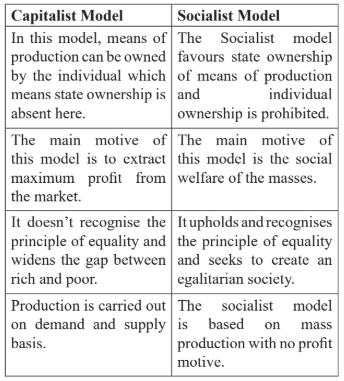
23. Explain any four features of the ideology of the Bharatiya Jana Sangh.
View AnswerAns. The Bharatiya Jana Sangh was formed in 1951. Its main features are
(i) The lineage of Bhartiya Jana Sangh can be traced back to the Rashtriya Swayamsevak Sangh (RSS) and the Hindu Mahasabha before independence.
(ii) It was different from other parties in terms of idcology and programmes. It emphasised the idea of one country, one culture and one nation. It believed that the country could become modern, progressive and strong on the basis of Indian culture and traditions.
(iii) The party called for a reunion of India and Pakistan in Akhand Bharat.
(iv) The party was in forefront of the agitation to replace English with Hindi as the official language of India. It was opposed to the granting of concessions to religious and cultural minorities.
SECTION-D
24. Study the given cartoon and answer the questions that follow.
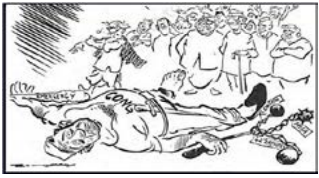
(i) Identify any two leaders who won the 1977 elections:
(A) Indira Gandhi and Sanjay Gandhi
(B) Morarji Desai and Atal Bihari Vajpayee
(C) Charan Singh and K.B. Sahay
(D) Jagjivan Ram and Raj Narain
View AnswerAns. (B) Morarji Desai and Atal Bihari Vajpayee
(ii) What is MISA?
(A) Military Internal Security Act
(B) Maintenance of International Security Act
(C) Maintenance of Internal Security Act
(D) Ministry of Internal Security Affairs
View AnswerAns. (C) Maintenance of Internal Security Act
(iii) Why was the Congress voted out of power in 1977 ?
(A) Economic reforms and increased foreign aid
(B) Imposition of emergency and misuse of laws
(C) Failure in conducting elections
(D) Increase in agricultural productivity
View AnswerAns. (B) Imposition of emergency and misuse of laws
(iv) Who became the first non-Congress Prime Minister of India after the 1977 elections?
(A) Charan Singh
(B) Morarji Desai
(C) Raj Narain
(D) Atal Bihari Vajpayee
View AnswerAns. (B) Morarji Desai
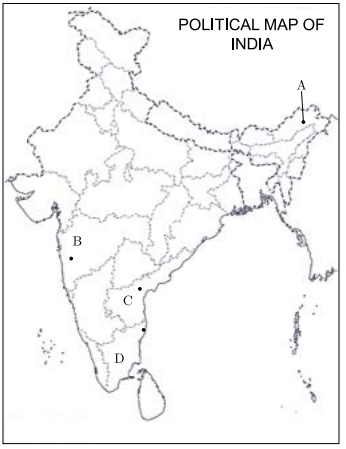
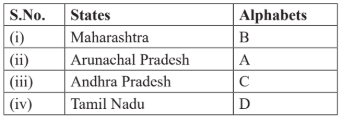
25. In the given political outline map of India, four states have been shown as A, B, C and D. Identify them on the basis of information given below and write their correct names in your answer book with the respective serial number of the information used and the concerned alphabets as per the following format.
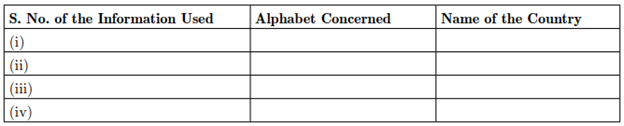
(i) Place where Congress Session of 1920 took place.
(ii) State which was known as North-East Frontier agency.
(iii) State where Potti Sriramulu, a Congress leader went on an indefinite fast that led to his death.
(iv) State which was earlier known as Madras Presidency.
Ans.
26. Read the passage given below carefully and answer the questions that follow. By 2011, the UN had 193 member states. These included almost all independent states. In the UN General Assembly, all members have one vote each. In the UN Security Council, there are five permanent members. These are: the United States, Russia, the United Kingdom, France and China.
These states were selected as permanent members as they were the most powerful immediately after the Second World War and they constituted the victory in the war.
(i) How many votes are given to each member of the General Assembly?
(A) One
(B) Zero
(C) Two
(D) None
View AnswerAns. (A) One
(ii) Which among the following state joined the UN before 2011 ?
(A) South Sudan
(B) Japan
(C) Vietnam
(D) Iraq
View AnswerAns. (A) South Sudan
(iii) Why only some states are part of permanent membership in the UN Security Council?
View AnswerAns. Some states are permanent members of the UN Security Council because they were the most powerful nations immediately after World War II and were part of the victorious alliance in the war. These include the United States, Russia, the United Kingdom, France and China.
SECTION –E
27. Define climate change and discuss any three global initiatives on climate change in detail.
View AnswerAns. Climate change refers to a long-term change in the average weather patterns that have come to define Earth’s local, regional and global climates.
The global initiatives taken on climate change are discussed below
(i) Montreal Protocol, 1987 It was a historical environmental accord that became a model for future diplomacy on the climate issue. Every country in the world eventually ratified the treaty, which required them to stop producing substances that damage the ozone layer, such as chlorofluorocarbons (CFCs). The protocol has succeeded in eliminating nearly 99 per cent of these ozone-depleting substances.
(ii) UN Framework Convention on Climate Change (UNFCCC), 1992 It was ratified by 197 countries including the United States. It is also considered a landmark accord or a first global treaty to explicitly address climate change. It established an annual forum, known as the Conference of the Parties, or COP, for international discussions aimed at stabilising the concentration of greenhouse gases in the atmosphere. These meetings produced the Kyoto Protocol and the Paris Agreement.
(iii) Kyoto Protocol, 2005 It was adopted in 1997 and came into force in 2005, which is the first legally binding climate treaty. It is an international agreement setting targets for industrialised countries to cut down their greenhouse gas emissions. China, India and other developing countries were exempted from the requirements of Kyoto Protocol.
OR
What is Kyoto Protocol? What is the importance of Kyoto Protocol? Is India a signatory to this?
View AnswerAns. Kyoto Protocol was adopted in 1997 and it came into force in 2005. It is the first legally binding climate treaty. It is an international agreement setting targets for industrialised countries to cut down their greenhouse gas emissions.
The significance of Kyoto Protocol is stated in the points below
(i) Kyoto Protocol frames an action plan so as to reduce emission of greenhouse gases proportionately for global North and global South countries of the world.
(ii) It had cleared the confusion regarding responsibilities of all countries belonging to global North and global South.
(iii) United Nations Framework Convention on Climate Change (UNFCCC) has set out the principles and allocated different targets for preserving global common. It decided that global North will provide global South with financial and technological resources so as to meet existing commitments.
(iv) India, China and other developing countries are exempted from the responsibility regarding reduction in greenhouse gas emissions.
Yes, India is a signatory to Kyoto Protocol.
28. Discuss the relationship between India and USA in the changing world order.
View AnswerAns. India’s relationship with the US on several issues has strengthened in the changing world order. This can be reflected in the following
(i) The US is the third-biggest source for Foreign Direct Investment into India.
(ii) India-US relations have become increasingly multi-faceted, covering cooperation in areas such as trade, defence and security, education, science and technology, civil nuclear energy, space technology and applications, environment and health.
(iii) Trade and economic partnership between the US and India have been a key component of the bilateral relationship. For instance, US Financial and Economic Partnership to strengthen bilateral engagement on macroeconomic, financial and investment-related issues were launched in April 2010.
(iv) The bilateral Strategic Energy Partnership was launched in April, 2018 under which India has started importing crude and LNG from the US. Now, the US is India’s sixth-largest source of crude oil imports and hydrocarbons.
(v) Inclusion of India and South Asia in the US Maritime Security Initiative are some of the significant initiatives which help to strengthen the Indo-US relations.
OR
Analyse India’s role in the Non-Aligned Movement.
View AnswerAns. India’s role in the Non-Aligned Movement: (i) Non-Alignment was a consistent feature of Indian
Foreign Policy by the late 1940s and it enjoyed strong support among the Indian elite. We can understand the role of India in Non-Aligned Movement as follows
(ii) The movement had its origins in the 1947 in New Delhi and the 1955 Asian African Conference in Bandung, Indonesia.
(iii) In Egypt, Lal Bahadur Shastri represented India and he put forward certain points for world peace such as border disputes, ban on nuclear weapons, etc.
(iv) In 1980, under Indira Gandhi, NAM focused on the relationship between disarmament and economic development by addressing to the economic grievances of developing countries.
(v) Through many efforts, India turned NAM into broad-based multi-ethnic and regional movement. Through NAM, India helped the world to shift its focus from the politics of confrontation to cooperation and co-existence.
(vi) India drew the world attention towards disarmament, human rights, NIEO, etc through the Non-Alignment movement.
(vii) India encouraged the freedom struggle in Asian and African countries from colonialism and imperialism. India was also a founding member of the group of fifteen, which were established at the 9th NAM summit in Belgrade in 1989 to facilitate discussion with the industrialised countries.
(viii) India was host to the 4th group of fifteenth summit in March, 1994. At the summit, Prime Minister Narsimha Rao was concerned over new trade barriers raised by the industrialised countries despite the conclusion of a new World Trade Agreement.
29. “Political parties are no longer aligned on ideological grounds in the new era of coalition politics”. Explain.
View AnswerAns. “Political parties are no longer aligned on ideological grounds in the new era of coalition politics”. This statement can be understood with the help of following points. These are
(i) Unstable Government The coalition government has its own interest and they fight for their own
self-interest. This leads to the breakup of not only of various fronts, but of governments as well.
(ii) Political Opportunism Government formed on the basis of coalition becomes selfish, as opportunist, power hungry and unscrupulous politicians focus on the self-interest only.
(iii) Lack of Polarisation The coalition governments are formed not on the basis of polarisation of political forces, but for the sake of capturing power and vested interest. There has been no sincere urge even among the parties of same ideology for political polarisation.
OR
Write about the establishment of Mandal Commission? Write any four recommendations of the commission.
View AnswerAns. In 1978, the Central Government established a commission to investigate and recommend methods to ameliorate (improve) the conditions of the poor. As a result, the commission was dubbed (termed) as the second backward classes commission. The Committee is commonly referred to as the Mandal Commission after its chairperson, Bindeshwari Prasad Mandal. Recommendations of the Mandal Commission was as below
(i) The Mandal Commission was set up to investigate the extent of education and social backwardness among various sections of Indian society. It recommended ways of identifying these backward classes. It was also expected to give its recommendations on the ways in which this backwardness could be ended. The commission gave its recommendations in 1980.
(ii) The Commission advised that ‘backward classes’ should be understood to mean ‘backward castes’ since many castes, other than the Scheduled Castes, were also treated as low in the caste hierarchy.
(iii) It recommended reserving 27 per cent of seats in the educational institutions and government jobs for these groups. The Mandal Commission also made many other recommendations like land reforms, to improve the conditions of OBC’s.
(iv) In August 1990, the National Front Government decided to implement one of the recommendations of Mandal Commission. It was related to reservations for OBC’s in jobs at the Central Government level and its undertakings.
30. “The regional parties have started playing an important role in the Indian political system”. Reflect on the given statement.
View AnswerAns. India as a democracy has the Multi-Party System which means there are several political parties competing for power. Apart from the primary parties, each state has their own local political parties that rule and compete in their region. Regional parties play following roles in Indian politics
(i) In absence of clear majority, the largest party has to join hands with a regional party in order to form government. This is where the importance of the regional parties comes into play.
(ii) Most of the regional parties have agenda fitting certain culture dominant within that state.
(iii) The regional parties for their benefits divide the people of different states on the line of language, culture, traditions, etc.
(iv) Sometimes serious issues like India’s Foreign Policy are influenced and compromised by regional parties. This affects India’s credibility in the global front.
(v) They also work as a pressure group in Indian politics.
(vi) Sometimes regional parties influence the Central Government to divert more annual budget funds to their states at the expense of other states.
OR
Name any three provisions of Article 370 which gives a special status to the state of Jammu and Kashmir. Analyse the two opposite reactions provoked by this special status among the people.
View AnswerAns. The three provisions which reflect special status to Jammu and Kashmir are
(i) Articles 370 of Indian Constitution gives greater autonomy to Jammu and Kashmir.
(ii) The state has its own Constitution.
(iii) All provisions of the Indian Constitution are not applicable to the state, law passed by the Parliament apply to Jammu and Kashmir only if the state agrees.
The two opposite reactions provoked by this special status among the people are
(i) People outside of Jammu and Kashmir believe that special status by Article 370 does not allow full integration with India. Thus, they demand cancellation of Article 370, so that Jammu and Kashmir could become like any other state in India.
(ii) Most of the Kashmiris believe that the autonomy conferred under Article 370 is not enough.