Business Studies (054)
Time: 3 Hours Max. Marks: 80
General Instructions:
1. This question paper contains 34 questions.
2. Marks are indicated against each question.
3. Answers should be brief and to the point.
4. Answers to the questions carrying 3 marks may be from 50 to 75 words.
5. Answers to the questions carrying 4 marks may be about 150 words.
6. Answers to the questions carrying 6 marks may be about 200 words.
1. HomeElectro Retailers, managed by CEO Mr. Karan Joshi, is a major distributor of household appliances. A customer purchased a washing machine from HomeElectro, which malfunctioned within two weeks of purchase. Despite multiple requests for repair, the store failed to address the issue satisfactorily. Frustrated, the customer filed a complaint with the Consumer Disputes Redressal Commission. The commission reviewed the case and ruled in favor of the customer, directing HomeElectro to either repair the faulty machine or provide a full refund. This case underscores the importance of consumer protection, highlighting consumers’ rights to seek redressal for defective products. It demonstrates how legal frameworks are in place to protect consumers from unfair trade practices and ensure they receive adequate remedies for grievances. Effective consumer protection mechanisms not only safeguard individual rights but also promote fair business practices, enhancing overall market trust and integrity. Which consumer right is exercised when the customer files a complaint with the Consumer Disputes Redressal Commission to seek a refund for a faulty washing machine?
(A) Right to safety
(B) Right to be informed
(C) Right to choose
(D) Right to seek redressal
View AnswerAns. (D) Right to seek redressal
2. HealthCare Innovations Ltd., led by Dr. Anjali Verma, views management as a science, art, and profession. As a science, they use data analytics to streamline operations and improve patient care. As an art, they encourage creative solutions to healthcare challenges. Recognizing management as a profession, HealthCare Innovations invests in continuous professional development and upholds ethical standards. This multifaceted approach ensures efficient operations, innovative healthcare solutions, and a commitment to professional integrity. How does HealthCare Innovations Ltd. exemplify management as an art?
(A) By using data analytics
(B) By encouraging creative solutions
(C) By investing in professional development
(D) By implementing systematic processes
View AnswerAns. (B) By encouraging creative solutions
3. The principle of ‘Authority and Responsibility’ by Fayol indicates that:
(A) Authority comes without responsibility
(B) Responsibility should exceed authority
(C) Authority and responsibility should be balanced
(D) Employees have authority over managers
View AnswerAns. (C) Authority and responsibility should be balanced
4. SecureBuild Construction closely monitors the political dimension of the business environment. Changes in government policies, such as new building regulations or infrastructure spending, directly impact their projects. By staying informed about political developments, SecureBuild adjusts its strategies, complies with regulations, and capitalizes on government contracts, ensuring smooth operations and growth despite political fluctuations.
How does SecureBuild Construction navigate the political dimension of the business environment?
(A) By ignoring government policies
(B) By staying informed about political developments and adjusting strategies
(C) By reducing compliance efforts
(D) By focusing solely on private contracts
View AnswerAns. (B) By staying informed about political developments and adjusting strategies
5. The most critical step in the planning process is:
(A) Developing premises
(B) Setting objectives
(C) Evaluating alternatives
(D) Allocating resources
View AnswerAns. (B) Setting objectives
6. BrightFuture Technologies maintains a formal organization with defined roles, hierarchical structures, and standardized procedures to ensure operational efficiency. Simultaneously, an informal organization thrives through employee friendships and spontaneous collaborations. The formal organization ensures tasks are completed efficiently, while the informal organization fosters a positive work environment, enhances communication, and promotes teamwork, contributing to overall organizational harmony and productivity. What advantage does BrightFuture Technologies gain from having both formal and informal organizations?
(A) Increased operational inefficiency
(B) Enhanced teamwork and operational efficiency
(C) Reduced employee morale
(D) Confusion in roles
View AnswerAns. (B) Enhanced teamwork and operational efficiency
7. Assertion (A): On-the-job training is conducted in a simulated environment.
Reason (R): On-the-job training allows employees to learn by performing their actual job tasks under supervision.
(A) Both A and R are correct, and R is the correct explanation of A.
(B) Both A and R are correct, but R is not the correct explanation of A.
(C) A is correct, but R is incorrect.
(D) Both A and R are incorrect.
View AnswerAns. (D) Both A and R are incorrect.
8. TechWave Innovations faces several barriers to effective communication within its teams. Language differences among international employees, technological glitches in communication tools, and hierarchical structures that limit open dialogue are major challenges. To overcome these barriers, TechWave implements multilingual training programs, invests in reliable communication technology, and fosters a culture of open communication where employees feel comfortable sharing ideas and feedback, thereby enhancing overall organizational communication. Which barrier to effective communication is TechWave Innovations addressing by implementing multilingual training programs?
(A) Technological glitches
(B) Language differences
(C) Hierarchical structures
(D) Lack of feedback
View AnswerAns. (B) Language differences
9. Assertion (A): Variance analysis is a tool used in financial control.
Reason (R): It involves comparing actual financial performance with budgeted figures.
Which of the following is correct?
(A) Both A and R are true and R is the correct explanation of A
(B) Both A and R are true but R is not the correct explanation of A
(C) A is true but R is false
(D) A is false but R is true
View AnswerAns. (A) Both A and R are true and R is the correct explanation of A
10. JKL Manufacturing is planning its capital structure. Given the current low-interest rates and tax benefits on debt, the management considers increasing debt in their financing mix. Which factor is JKL Manufacturing primarily considering in its capital structure decision?
(A) Business Risk
(B) Tax Considerations
(C) Operational Efficiency
(D) Dividend Policy
View AnswerAns. (B) Tax Considerations
11. Read the following statements carefully:
Statement I: A commercial paper is an unsecured, short-term debt instrument issued by corporations.
Statement II: Certificate of deposit is a negotiable instrument issued by commercial banks. In light of the given statements, choose the correct alternative:
(A) Both statements are true.
(B) Both statements are false.
(C) Statement I is true, Statement II is false.
(D) Statement II is true, Statement I is false.
View AnswerAns. (A) Both statements are true.
12. Read the following statements carefully:
Statement I: Place or distribution is concerned with making products available to customers at the right time and place.
Statement II: A zero-level channel involves intermediaries between the producer and consumer. In light of the given statements, choose the correct alternative:
(A) Both statements are true.
(B) Both statements are false.
(C) Statement I is true, Statement II is false.
(D) Statement II is true, Statement I is false.
View AnswerAns. (C) Statement I is true, Statement II is false.
13. Identify the correct sequence of steps in the controlling process:
(A) Setting standards, Measuring performance, Taking corrective action, Comparing performance
(B) Measuring performance, Setting standards, Comparing performance, Taking corrective action
(C) Setting standards, Measuring performance, Comparing performance, Taking corrective action
(D) Comparing performance, Setting standards, Measuring performance, Taking corrective action
View AnswerAns. (C) Setting standards, Measuring performance, Comparing performance, Taking corrective action
14. Match the list I with list II and select correct option.
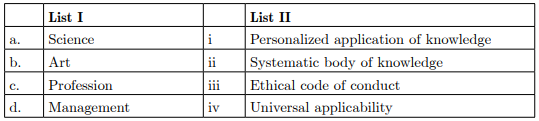
Options:
(A) a-ii, b-i, c-iv, d-iii
(B) a-iv, b-ii, c-iii, d-i
(C) a-ii, b-i, c-iii, d-iv;
(D) a-i, b-iii, c-ii, d-iv;
View AnswerAns. (C) a-ii, b-i, c-iii, d-iv;
15. Which of the following is/are correct regarding the importance of business environment?
1. It helps businesses identify potential opportunities.
2. It provides insight into market conditions.
3. It reduces the risk of unexpected changes in policies.
4. It promotes better decision-making.
(A) Only 1 and 4
(B) Only 1, 2, and 4
(C) Only 3 and 4
(D) All of the above
View AnswerAns. (B) Only 1, 2, and 4
16. Choose the levels of packaging depicted in the picture.

(A) Secondary Packaging and Transportation Packaging
(B) Primary Package and Secondary Packaging
(C) Primary Package and Transportation Packaging
(D) None of these
View AnswerAns. (B) Primary Package and Secondary Packaging
17. Which of the following steps is NOT part of the organizing process?
(A) Identifying activities
(B) Assigning tasks
(C) Establishing relationships
(D) Controlling activities
View AnswerAns. (D) Controlling activities
18. Which of the following statements is correct about employee referrals as a recruitment source?
(A) Employee referrals are considered an external recruitment source.
(B) Employee referrals often lead to higher-quality hires due to existing employees recommending suitable candidates.
(C) Employee referrals are always more expensive than other recruitment methods.
(D) Employee referrals limit the diversity of the workforce.
View AnswerAns. (B) Employee referrals often lead to higher-quality hires due to existing employees recommending suitable candidates.
19. Which of the following statements about financial incentives is NOT correct?
(A) Financial incentives include bonuses and salary increments.
(B) Financial incentives directly increase an employee’s take-home pay.
(C) Financial incentives have no impact on employee motivation.
(D) Profit sharing is considered a financial incentive.
View AnswerAns. (C) Financial incentives have no impact on employee motivation.
20. Which of the following statements is NOT correct regarding the steps in the controlling process?
(A) Establishing standards is the first step.
(B) Measuring actual performance follows establishing standards.
(C) Ignoring deviations is a step in the controlling process.
(D) Taking corrective action is the final step
View AnswerAns. (C) Ignoring deviations is a step in the controlling process.
21. GK Goenka started a Publishing house named ‘Entire’ signifying the wide range of books it will offer ranging from comic series for children to novels and documentaries for serious readers. As a part of its marketing strategy, it decided to organise a mega reading event for which it even opened a facebook page through which it invited people to come, attend and like the event. The event gave special invitation to the underprivileged children and to the orphanages who do not have access to such facilities. Prabhakar wanted to gain a lot of publicity through this. Do you think the brand name ‘Entire’ is relevant in context of the publishing house started by GK Goenka.
Give any two reasons to justify your answer.
View AnswerAns. Yes the brand name ‘Entire’ is relevant in context of the publishing house started by Prabhakar as it has the following features of a good brand name.
(a) Suggestive: A brand should suggest the product’s benefits and qualities. The name ‘Entire’ suggests the wide variety of books they will offer.
(b) Versatile: A brand name should be sufficiently versatile to accommodate new products, which are added to the product line. The brand name ‘Entire’ has the capability to accommodate as much variety of books to it as possible.
22. Identify and explain the dimensions of Business Environment in the following cases:
(a) It is mandatory to give a statutory statement on the Mutual Fund Investment documents- “Mutual Fund Investments are subject to market risk. Please read the offer document carefully before investing”.
(b) Small business will now move towards transaction of business affairs in plastic money. This will lead to use of internet, new gadgets, etc. and reduce dependence on cash. Report generation of these transactions will be helpful in acting as a proof for the betterment of future business.
View AnswerAns. (a) Legal environment: It consists of legislation that has been passed by the Parliament and State Legislatures. This component prescribes rules or laws that all members of business community must follow. In the question, statutory statement on Mutual Fund Investment document has been made statutory by Law.
(b) Technological environment: Due to technological advancement in the way of business transactions a cash-lite economy is created. The digital transactions can be done with the internet connected computer or mobile phones. More of Point of Sales (POS) machines will be installed to facilitate transactions.
23. Explain any three features of planning.
View AnswerAns. (a) Planning is goal-oriented: Organisations are set up with a general purpose in view. Specific goals are set out in the plans along with the activities to be undertaken to achieve the goals. Thus, planning is purposeful. Planning has no meaning unless it contributes to the achievement of predetermined organisational goals.
(b) Primacy of planning: It lays down the base for other functions of management. All other managerial functions are performed within the framework of plans drawn. Thus, planning precedes other functions. This is also referred to as the primacy of planning
(c) Planning is pervasive: It is needed in all types of organisations, whether big or small, profit or non-profit, social, political or religious. It is required at all levels of management as well as in all departments of the organisation. It is neither an exclusive function of top management nor of any particular department. But the scope of planning differs at different levels and among different departments. For example, the top management undertakes planning for the organisation as a whole. Middle management does the departmental planning. Lower level management does day to day operational planning.
OR
Explain any three points highlighting the importance of planning.
View AnswerAns. The three points highlighting the importance of planning are:
(a) Makes objectives clear and specific: The planning exercise makes the goals clear and specific because it begins with the determination of objectives.
(b) Makes activities meaningful/Provides directions: Due to planning, employees and managers know how their activities relate to organisational goals. Everyone is conscious of his own contribution towards achievement of organisational goals. In this way, planning makes activities meaningful.
(c) Reduces the risks of uncertainty: Planning helps to reduce the risks associated with uncertainties. In the process of planning, attempt is made to look into the future and predict it. Planning helps to identify potential threats of future and help to develop contingency plan to deal with them.
(d) Facilitates decision-making: Planning ensures foreseeing future and choosing the best alternative amongst the various alternatives. The manager evaluates the positive and negative aspect of each alternative and choose the one with least negative consequence, having feasibility and profitability. Through this, a direction is provided to all the activities of the organisation which gives the basic guidelines to the manager for decision making.
24. Decentralisation is an optional policy. Explain why an organisation would choose to be decentralised.
View AnswerAns. Decentralisation is an optional policy, yet an organisation chooses to be decentralised because of its importance which is as follows:
(a) Develops initiative among subordinates: Decentralisation gives authority to the employees to take decisions. This promotes self-reliance and confidence among them.
(b) Develops managerial talent: Through decentralisation, the employees prove their abilities and create a reservoir of qualified manpower that can take up higher positions in the near future.
(c) Quick decision-making: Decisions are taken at a level nearest to the point of action. Further, no approval is required which ensures quick decision-making.
(d) Relief to top management: The top management can devote more time to make important policy decisions. There is little need for personal supervision as other forms of control such as return on investment are there.
OR
You are a manager in a toy manufacturing company. How will you perform the job of ‘grouping of activities’ as a step towards process of organisation?
View AnswerAns. A toy manufacturing company performs various activities such as purchase of raw material, purchase of manufactured parts, recruitment, training, manufacturing, arranging for funds, investment decisions, advertisement, research, etc. All similar activities are placed under one group. Activities relating to purchase of raw material, purchase of ready-made parts, assembling of various parts and segregation of finished products, etc. are assigned to production department. Similarly, other activities such as recruitment, training, etc. can be grouped under staffing, arranging for funds and investment decision can be grouped under finance, advertisement and research function under marketing etc.
These steps help in the optimum utilisation of 3 M’s, i.e., Men, Material and Machinery and lead to specialisation too.
25. ‘The right people can help to take a business to the top; the wrong people can break the business’.
Identify the management function indicated in the statement and explain its importance.
View AnswerAns. Staffing is the managerial function of filling and keeping the positions filled in the organisation structure. This function ensures the following advantages to a concern:
(a) It helps in knowing the quantity and quality of man-force required.
(b) It ensures higher performance by putting right person on the right job.
(c) It ensures continuous survival and growth of the enterprise through the succession planning of managers.
26. In the organisational context basic salary helps to satisfy the basic physiological needs of hunger, thirst, shelter, sleep etc. How are the remaining needs given by Maslow in his need hierarchy are satisfied? Explain briefly.
View AnswerAns. (a) Safety and security needs are satisfied by providing job security, stability of income etc. to the employees.
(b) Affiliation/belonging needs are satisfied through informal organisation and cordial relations among employees.
(c) Esteem needs are satisfied by giving job titles. (d) Self-actualisation needs are satisfied by allowing the employees to take initiative to become what they are capable of becoming.
27. Ms. Sushma recently completed her Post Graduate Diploma in Human Resource Management. A few months from now, a large steel manufacturing company appointed her as its Human Resource Manager. As of now, the company has 800 persons as employees and has an expansion plan in hand which may require 80 persons more for various types of additional requirements. Ms. Sushma has been given complete charge of the company’s Human Resource Department. Ms. Sushma designed rigorous selection procedure to ensure right person is placed on different posts.
Explain various steps Ms. Sushma needs to perform during selection of an employee after a candidate cleared the employment interview and reference checking.
View AnswerAns. Ms Sushma needs to perform the following steps further:
(a) Selection decision: After the candidate passes the tests and interviews, final decision for selection is made after considering the views of concerned manager.
(b) Medical test: The selection process is not complete without the medical or physical test. A candidate who successfully crosses all the hurdles and passes the medical test, is then appointed and an appointment letter is issued to him as per the terms and conditions agreed between the employer and the employee.
(c) Job offer: Letter of appointment mentioning the date by which a candidate has to report on duty is handed over to the appointee who has cleared all hurdles.
(d) Contract of employment: It includes various details such as pay, allowances, leave rules, work rules, hours of work, disciplinary procedure, etc. It is prepared after the acceptance of job offer by candidate and attestation form attested by him.
28. Rozar purchased an ISI mark electric iron from ‘Newer Electronics’. While using, he found that it was not working properly. He approached the seller to complain for the same. The seller satisfies Rozar by saying that he would ask the manufacturer to replace this iron. The manufacturer refuses to entertain the complain and ‘Newer Electronics’ decided to file a complaint in the consumer court. Can ‘Newer Electronics’ do this?
Why? Also, explain ‘who is a consumer’ as per the Consumer Protection Act, 2019.
View AnswerAns. Newer Electronics can not file a complaint. This is because Newer Electronics is not a consumer as per Consumer Protection Act, 2019 as Newer Electronics bought the goods for re-sale/commercial purpose. Under the Consumer Protection Act 2019, a consumer is a person who buys any goods or avails services for a consideration, which has been paid or promised, or partly paid and partly promised, or under any scheme of deferred payment. It includes any user of such goods or beneficiary of services if such use is made with the approval of the buyer. It applies to both offline and online transactions through electronic means or by tele shopping or direct selling or multilevel marketing.
However, any person who obtains goods or avails services for resale or commercial purpose is not treated as a consumer and is outside the scope of Consumer Protection Act 2019.
OR
Ankur bought a pack of toothpaste and a toothbrush from a shop. After returning home, he opened them, discarded the outer pack of both the products and started using them. Explain the levels of packaging for both products giving reference to their packaging.
View AnswerAns. Ankur discarded secondary pack of toothpaste and primary pack of toothbrush. The following are the different levels of packaging:
(a) Primary packaging: It refers to the product’s immediate container. This is kept by the customers till the product is ready to use (c.g. outer pack of toothbrush) or is kept throughout the entire life of the product (as in case of tube of toothpaste). (b) Secondary packaging: It is the additional layer of protection that is kept till the product is ready for use. The cardboard box with the tube of toothpaste is secondary package.
(c) Transport packaging: These are corrugated boxes containing units in bulk to facilitate transportation, storage and identification.
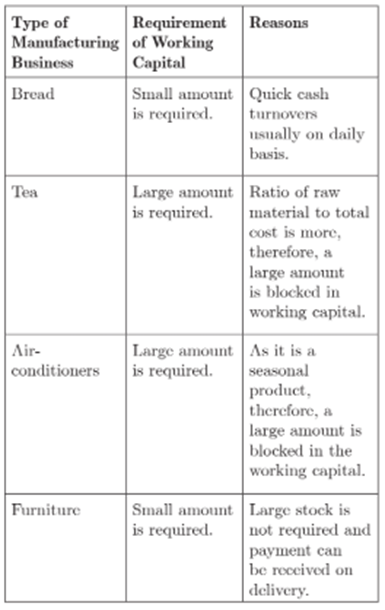
29. Mr. Bothra, wants to start a manufacturing business, approaches you to advise him with reasons whether the following manufacturing businesses would require large or small working capital:
(a) Bread
(b) Tea
(c) Air-conditioners
(d) Furniture
View AnswerAns.
30. “Management is both a science as well as an art.” In the light of this statement, explain the nature of management.
View AnswerAns. Science is a systematised body of knowledge which explains the cause and effect relationship based on certain principles of general application.
(a) Management is a science because:
(i) It is a systematised body of knowledge derived through observation and research and applied in the form of various principles and theories.
(ii) Many of the management principles are universal in nature. However, due to human factor involved in an organisation, it becomes inexact or social science. It is interdisciplinary, drawing knowledge from various other disciplines, such as mathematics, economics and psychology.
(b) An art is the systematic application of skill to accomplish a desired concrete result. A manager will not be able to achieve organisational objectives unless he knows the art of putting theoretical knowledge into practice. Thus, management is an exact art.
OR
Identify and explain the principle of management being violated in the following situations:
(a) When manager grants one month medical leave to a supervisor with pay and only one week medical leave to an accountant.
(b) When worker is wasting time in search of toolbox in the organisation.
View AnswerAns. Ans. (a) Principle of equity: This principle emphasises kindliness and justice in the behaviour of managers towards workers. This will ensure their loyalty and devotion. There should be no discrimination against anyone on account of sex, religion, language, caste or nationality, etc. The manager should have a good sense and experience to ensure fairness to all the employees. Further, stern action should be taken against lazy personnel to send a message that everyone is equal in the eyes of management.
(b) Principle of order: This principle lays stress on material and social arrangement within the organisation. Orderliness means that there should be a place for everything and everything should be at its place for smooth working. This will ensure that no wasteful movement for searching any tool, material or instrument will be there and the concerned person can be contacted timely.
For example, there should be proper place for all tools, raw materials etc. and proper place for different employees of organisation.
31. (a) “An ideal control technique is the one that checks on every stage in the process of production.” Comment.
View AnswerAns. (a) This statement is not fully appropriate. It becomes difficult to exercise control at every stage and thus, some deviations are bound to occur. Minor deviations should be ignored and some critical points in the performance should be identified. If these points pass the requisite standards, the entire performance may be taken as perfect. This principle is known as ‘management by exception’. This principle implies that if control is to be effective and economical, it must focus attention on the factors which are critical and require more attention.
(b) Explain the steps of controlling process after comparison of actual performance with standard performance.
View AnswerAns. (b) (i) Analysing Deviations: It is important to analyse the causes of deviations. Acceptable range of deviations should be determined. If performance matches the standards, managers may assume that everything is under control. If performance falls short of standards, managers must find out the extent of deviation. Generally, minor deviations do not require managerial attention. To save time, managers concentrate on major deviations only. For example, if actual production on a particular day is short of target by a few units, it may be ignored. But if it continues and monthly production is short of the target by a large quantity, it must be regarded as a serious matter. Deviations in key areas of business need to be attended more urgently as compared to deviations in certain insignificant areas. Only significant deviations which go beyond the permissible unit should be brought to the notice of management.
(ii) Taking corrective action: The purpose of control is not only to detect errors and defects in performance of work but also to adopt remedial measures. Corrective actions are, therefore, initiated on the basis of factors causing deviations between standards and actual results. For example, actual performance may fall short of standards due to outdated machines or absence of adequate incentives to workmen. This can be rectified by installing up-to-date machinery or offering suitable incentives to workers for better performance. Thus, a corrective action may involve a change in methods, machinery, rules or procedure. Improving physical conditions of work or changing the nature of supervision may also be necessary at times. Where the deviations cannot be rectified through managerial action, the standards may have to be revised.
32. Samir Gupta started a telecommunication company Airways Mobile Private Limited to manufacture economical mobile phones for the Indian rural market with fifteen employees. The company did very well in its initial years. As the product was good and marketed well, the demand of its product went up. To increase production the company decided to recruit additional employees. Samir Gupta, who was earliest taking all decision for the company had to selectively disperse the authority. He believed that subordinates are competent, capable, and resourceful and can assure responsibility for effective implementation of their decisions. This paid off and the company was not only able to increase its production but also expanded its product range.
(a) Identify the concept used by Samir Gupta through which he was able to steer his company to greater heights.
(b) Also explain any three points of importance of this concepts.
View AnswerAns. Decentralisation is the process of decision making where the authority to decide is delegated or shared among all levels of management. The organisation where even the lower level of management is involved in decision-making is called as decentralised organisation.
Importance of Decentralisation:
1. Develops initiative among subordinates: Freedom given to the lower managerial levels to take decision encourages them to take initiatives to find more effective ways of fulfilling responsibilities.
2. Relief to top management: It enables top management to focus on strategic and policy related decisions.
3. Facilitates growth: Power to decide and manage leads to better performance, increased productivity and higher returns. Management may use opportunities for expansion and growth.
4. Better control: Specifically assigned responsibilities make it easier to fix accountability and answerability. Feedbacks and performance evaluations helps to control business better.
33. How are shareholders likely to gain with a loan component in the capital employed? Explain with a suitable example.
View AnswerAns. Earnings per share of equity shareholders increase by the use of borrowed component in the capital structure due to the following two reasons:
(a) This is because debt/loans carry a fixed charge.
(b) Interest is tax-deductible, i.e., interest paid on debt is deducted from profits while calculating tax.
The benefit to the shareholders will be realised only if the average rate of return on total capital invested is more than the rate of interest payable on loan/ debt.
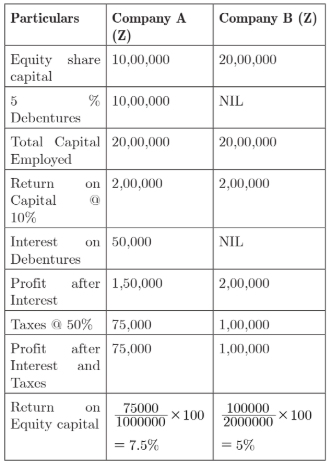
The rate of return on equity capital is higher in case of company A as it has made use of debentures in its capital structure.
OR
Explain any four factors affecting financial decision which determines the amount of profit earned to be distributed and to be retained in the business.
View AnswerAns. Factors affecting the dividend policy/decision of a company are:
(a) Growth opportunities/Financial requirements of the company: If a company has a number of projects to invest in, then it should reinvest the earnings of the company. In this case, the company would prefer to pay low dividends to shareholders and invest the remaining profits in the business. But if the company has no investment/growth avenues open, then it would be better to distribute carnings as dividends to shareholders.
(b) Stability of dividends: Most companies follow a stable dividend policy. This policy has a favourable impact on the market value of shares and shareholders also prefer stable dividends than fluctuating ones. Stable dividends have certain advantages as they resolve uncertainty in the minds of investors and satisfies their desire for current income. Even financial institutions like IFCI, IDBI, UTI also prefer investing in those companies, which follow at policy of paying regular dividends.
(c) Access to Capital Market/Capital market consideration: When a company requires funds for investments, it can either tap the capital market and raise additional equity or retain its earnings by declaring low dividends. If the capital market is easily accessible to the company, then it can afford to follow a liberal dividend policy. However, if a company has limited access to capital markets then, it will pay low dividends to shareholders and rely more on retained earnings to finance their long- term projects.
(d) Shareholders’ preference: Small and retired shareholders who invest their savings in shares in the hope of getting a regular income are interested in a stable and regular dividend. The management may follow a policy which serves the purpose of the majority group. Wealthy investors usually invest in shares for earning capital gains. They are in high income tax brackets and therefore, may not prefer current dividends, as their taxes would increase.
(e) Legal restrictions: Companies Act has certain provisions regarding payment of dividends. Dividends can be paid only out of current profits or past profits after providing for depreciation. Companies are not allowed to pay dividends out of the paid up capital as this amounts to reduction in capital. Then, there are certain internal constraints in the company like whether there is enough cash to pay dividends and what is the company’s liquidity position. Financial institutions also provide certain conditions in their loan agreements. Thus, the dividend decision depends upon these legal and internal constraints.
34. Reena went to the market and purchased 2 litre fruit juice in tetrapack. She did not check the information provided on the pack. She fell sick on consuming it as the juice has expired. She wanted to file a case in the district forum under the Consumer Protection Act but was denied as she did not fulfilled her responsibilities. Explain different consumer responsibilities as per the Act.
View AnswerAns. The various responsibilities of a consumer are:
(a) Must exercise his/her rights: Consumers must be aware of their own rights with regard to the products or services they buy from the markets and should exercise them whenever required.
(b) Cautious consumer: A consumer must be cautious before purchasing, any good or service. He must insist on getting full information on the quality, quantity, utility, price, etc. of the good or service. This will ensure a better purchase.
(c) Filing complaints: Sometimes, consumers ignore the loss incurred believing that the loss is small but this attitude encourages corrupt business practices to continue. So, a consumer should file complaints for the redressal of genuine grievances.
(d) Quality conscious: A consumer must be quality conscious. He should look for quality certification marks like ISI, Agmark, FPO, Woolmark, etc. while making purchases.
(e) Insist on cash memo: A consumer must ask for cash memo from the shopkeeper because if there is any defect in the goods purchased and consumer has to make a complaint, the cash memo must be there as a proof of purchase. A seller is always bound to give a cash memo.
(f) Advertisements often exaggerate: Consumers should compare the uses of the product given in the advertisement copy and the actual product. Any discrepancy should be brought to the notice of the sponsor of the advertisement.
(g) Honest in dealings: A consumer must choose only legal goods and services to discourage unscrupulous practices like black marketing, hoarding etc.
(h) Use products as per manufacturer’s instructions: Consumers should learn about the risks associated with products and services. so a consumer must follow manufacturer’s instructions to use the products safely.
OR
Arjun, after working as a chef in a reputed restaurant, started his business of catering. He gave the name Dana Pani to his concern and is very particular about the quality of his products. He advertised his products on different TV channels to make people aware about the services. He wants to fix prices for his products and services.
Explain the major factors affecting the price mix of a product to him.
View AnswerAns. The factors that affect the determination of a product or service are:
(a) Product cost: The cost of producing, distributing and selling a product sets the minimum level at which a product may be sold. All the firms strive to cover the cost of a product plus a margin of profit above it.
(b) Utility and demand of the product: Utility or satisfaction derived by a consumer from a product and the intensity of his demand sets the upper price limit for a product. The buyer is ready to pay up to a point where utility from the product is at least equal to sacrifice made in terms of money paid for it. Similarly, if the demand is elastic, a small change in the price results in a large change in the quantity demanded; and if the demand of a product is inelastic, the firm is in a better position to set the price.
(c) Extent of competition in the market: The nature and degree of competition in the market also affects the pricing of a product. Competitors’ prices and their anticipated reactions are considered before fixing the price of a product.
(d) Government and legal regulations: The Government intervenes and regulates the price of commodities. It can declare a product as an essential product and regulate its price. Thus, while fixing the price, the government and legal regulations should be taken into consideration.
(e) Pricing objectives: Generally, a firm’s objective to set the price of a product is considered while pricing the product. A firm which aims at maximising profit in the short run tends to fix a price on the higher side, as compared to the price set when the objective is to maximise profit in the long run. Similarly, if the objective is to capture the market share, prices can be set at a level lower than that of its competitors. (f) Marketing methods used: The marketing methods used such as research activity undertaken, salesmen employed, amount of advertising, product differentiation, packaging, credit facility etc. affect price fixation. If a firm has some unique element of marketing, it gives the firm a competitive freedom in fixing the price of its products.