SECTION – A
1. Identify the Asana shown in the below image
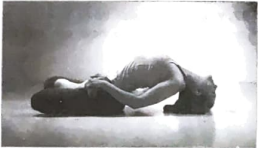
(a) Bhujangasana
(b) Ushtrasana
(c) Matsyasana
(d) Vakrasana
View AnswerAns. (c) Matsyasana
2. Which type of tournaments are generally conducted in individual games i.e., boxing, tennis, etc?
(a) Challenge
(b) League cum knockout
(c) Staircase
(d) Cyclic
View AnswerAns. (a) Challenge
3. Kautilya, a class XII student got confused during his physical education class about how the involvement of Newton’s laws of motion is useful in sports and how these laws can be applied in sports. When he asked his teacher, he explained these laws to him by providing some examples from sports. Later on, his teacher assessed him by asking that swimming is the best example of which law(s) of motion. Help Kautilya to answer this question by selecting the appropriate option.
(a) Law of reaction
(b) Law of acceleration
(c) Law of inertia
(d) Both (a) and (c)
View AnswerAns. (d) Both (a) and (c)
4. Which is the branch of science that refers to all the processes by which an individual digests his/her food?
(a) Nutrition
(b) Excretion
(c) Nutrients
(d) Water
View AnswerAns. (a) Nutrition
5. In _____________ blood glucose level is high.
(a) Obesity
(b) Diabetes
(c) Hypertension
(d) Sinusitis
View AnswerAns. (b) Diabetes
6. If 8 teams are participating in double league tournament, then the number of matches will be:
(a) 30
(b) 42
(c) 48
(d) 56
View AnswerAns. (d) 56
7. Given below are two statements, one of which is labelled as Assertion (A) and the other is labelled as Reason (R)
Assertion (A): Bhujangasana and Tadasana can treat lordosis.
Reason (R): The asanas strengthen the muscles and help in maintaining balance of the body
Which of the following statements is correct?
(a) Both (A) and (R) are true and (R) is the correct explanation of (A)
(b) Both (A) and (R) are true and (R) is the not correct explanation of (A)
(c) (A) is true but (R) is false
(d) (A) is false but (R) is true
View AnswerAns. (d) (A) is false but (R) is true
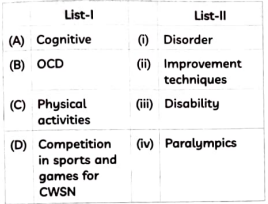
8. Match list I with list II and select the correct option from the given codes.
Codes:
(a) (A) – (iii), (B) – (i), (C) – (ii), (D) – (iv)
(b) (A) – (iv), (B) – (ii), (C) – (i), (D) – (iii)
(c) (A) – (ii), (B) – (iii), (C) – (iv), (D) – (i)
(d) (A) – (iv), (B) – (iii), (C) – (i), (D) – (ii)
View AnswerAns. (a) (A) – (iii), (B) – (i), (C) – (ii), (D) – (iv)
9. Given below are two statements, one of which is labelled as Assertion (A) and the other is labelled as Reason (R).
Assertion (A): Scoliosis is an abnormal lateral curvature of spine.
Reason (R): In worst case, a person may need a surgery to straighten the curves.
Which one of the following statements is correct?
(a) Both (A) and (R) are true and (R) is the correct explanation of (A)
(b) Both (A) and (R) are true and (R) is the not correct explanation of (A)
(c) (A) is true but (R) is false
(d) (A) is false but (R) is true
View AnswerAns. (b) Both (A) and (R) are true and (R) is the not correct explanation of (A)
10. Which of the following is NOT a cause of flat foot deformity?
(a) Lack of vitamin D and calcium
(b) Faulty posture
(c) Body heaviness
(d) Standing for a long time
View AnswerAns. (a) Lack of vitamin D and calcium
11. Which fo the following test is used to measure speed and agility?
(a) Half Marathon race
(b) 100 m race
(c) 1.5 km run
(d) 4 x 10 m Shuttle run
View AnswerAns. (d) 4 x 10 m Shuttle run
12. What is the aim of conducting partial curl up test?
(a) Test weight loss
(b) Test abdominal strength
(c) Test brain activity
(d) Test back strength
View AnswerAns. (b) Test abdominal strength
13. What is the amount of blood pressure into one ventricle per beat?
(a) 80 to 90 mL/beat
(b) 70 to 90 mL/beat
(c) 50 to 60 mL/beat
(d) 60 to 90 mL/beat
View AnswerAns. (b) 70 to 90 mL/beat
14. Which of the following practices is helpful in assessing non-serious injuries?
(a) TOTAPS
(b) Immobilization
(c) RICE
(d) None of these
View AnswerAns. (a) TOTAPS
15. The movement that occurs between long bones, causing a change in the angle between two bones:
(a) Gliding movement
(b) Flexing movement
(c) Circular motion
(d) Angular movement
View AnswerAns. (d) Angular movement
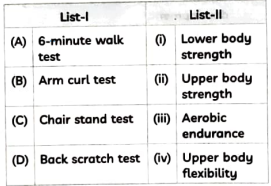
16. Match list I with list II and select the correct option from the codes given below:
Codes:
(a) (A) – (i), (B) – (ii), (C) – (iii), (D) – (iv)
(b) (A) – (iv), (B) – (ii), (C) – (iii), (D) – (i)
(c) (A) – (iii), (B) – (ii), (C) – (i), (D) – (iv)
(d) (A) – (iii), (B) – (i), (C) – (iv), (D) – (ii)
View AnswerAns. (c) (A) – (iii), (B) – (ii), (C) – (i), (D) – (iv)
17. A six-minute walk test for a senior citizen measures which of the following?
(a) Upper body fitness
(b) Lower body fitness
(c) Walking fitness
(d) Functional fitness
View AnswerAns. (c) Walking fitness
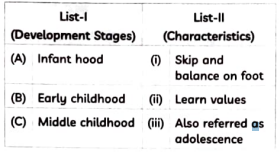
18. Match list I with list II and select the correct option from the codes given below:
Codes:
(a) (A) – (iii), (B) – (ii), (C) – (i), (D) – (iv)
(b) (A) – (iv), (B) – (i), (C) – (ii), (D) – (iii)
(c) (A) – (i), (B) – (ii), (C) – (iii), (D) – (iv)
(d) (A) – (ii), (B) – (iii), (C) – (i), (D) – (iv)
View AnswerAns. (b) (A) – (iv), (B) – (i), (C) – (ii), (D) – (iii)
SECTION – B
19. Draw a fixture of 11 football teams participating in a tournament on the basis of knockout.
View AnswerAns.
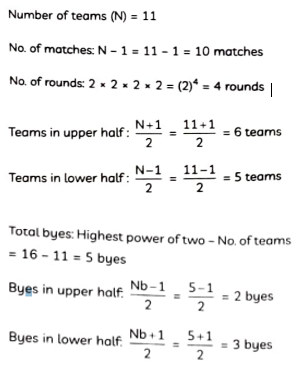
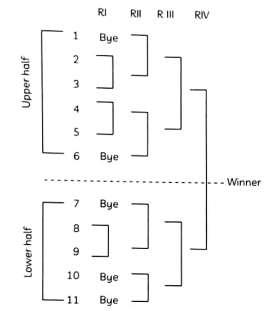
20. Proper nutrition is a cornerstone of athletic performance. Consuming the right foods before exercise can significantly enhance energy levels, endurance, and overall athletic output. What constitutes an ideal pre-workout meal?
View AnswerAns. To maximize athletic performance, an ideal pre-workout meal should consist of a balanced blend of nutrients. Making complex carbs a priority gives an athlete long-lasting energy. while lean protein helps muscles to recover and rebuild. Including modest amounts of fat ensures satiety and promotes overall wellness. Whole-grain toast with avocado and a cooked egg. yogurt with honey and almonds, or a chicken salad sandwich on whole-grain bread are a few examples of healthy pre-workout meals.
21. Enlist the benefits of Bhujangasana.
View AnswerAns. Following are the benefits of Bhujangasana:
(1) It relaxes body and mind.
(2) It improves digestive functioning.
(3) It cures cold and bronchial problems.
(4) It cures diabetes and arthritis.
(5) It opens the chest and increases oxygen supply to the lungs.
(6) It removes liver problems.
22. What is the role of a school in encouraging participation of CWSN in P.E?
View AnswerAns. Students’ motor skills should be improved in order to boost one’s sense of worth and inspire sportsmanship, to build social skills for societal transformation, to provide people with the opportunity to participate in a variety of appropriate recreational and leisure-time sports and activities while acquiring new skills This is how schools encourage participation of CWSN in PE.
23. Enlist any two causes of Obesity.
View AnswerAns. Following are the causes of obesity:
(1) Imbalance between calories intake and calories consumed: When a person takes a large amount of food, he/she gets more calories. If he/she does not do physical work, then due to imbalance between calories consumed and calories intake, the extra calories are deposited the form of fats. Thus, the person becomes obese.
(2) Heredity: Heredity is also a cause of obesity. It is seen that if the parents are obese, their children are likely to be obese.
(3) Endocrine gland functioning: When the thyroid gland secretes less amount of thyroxin (Hypothyroidism). a person becomes obese.
24. Enlist the spinal postural deformities. Explain the causes of kyphosis.
View AnswerAns. Spinal postural deformities are:
(1) Kyphosis
(2) Lordosis
(3) Scoliosis
Following are the causes of kyphosis:
(1) Bad posture during work: People who adopt a poor posture for long periods, such as frequently working at a computer.
(2) Weakening of muscles: Where the bones become weak and fragile and are more likely to break (fracture).
(3) Carrying heavy load on shoulders: Poor posture in childhood, such as slouching. leaning back chairs and carrying heavy schoolbags, can cause the ligaments and muscles that support the vertebrae to stretch. This can pull the thoracic vertebrae out of their normal position.
SECTION – C
25. Write briefly about modified pushups (girls) test.
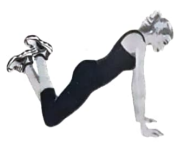
Ans. Push-ups are regarded as one of the most effective upper body exercises. These can be done anywhere. These strengthen several muscles.
Modified push-ups are a variation of regular pushups and are also known as knee push-ups. As the upper body’s strength in girls 15 comparatively lesser, it is a good exercise for them.
This exercise is used by people who have limited upper body strength or have had some injury. It is done with knees slightly bent and touching the ground.
Procedure: To perform this exercise, sit on a mat in a kneeling position. Keep the body below the shoulders and the knees behind your hips so that your back is angled and long. Tuck your toes under, tighten the stomach and bend elbows to the lower chest toward the floor, press the chest back to the start position. Repeat the exercise as per your desire.
Score: The total number of correct push-ups done in one minute.
26. Explain the factors affecting motor development.
View AnswerAns. Factors affecting motor development are as follows:
(1) Heredity: Motor development largely depends on genetic factors. Many attributes like height, body weight, muscle mass, etc., are acquired from parents.
(2) Environment: Encouragement, love and security of children help them take risks and know more about the environment. This effort leads to better sensory development of children, which is a pre-requisite of motor development.
(3) Physical activity: Regular physical activities always promote motor development. These activities should be planned according to the age.
(4) Nutrition: Proper nutrition always leads to good motor development.
(5) Immunization: Timely immunization of mother and child always facilitate better sensory motor development
(6) Age or maturity: Infancy and pre-school years are a period of rapid motor development. In later childhood and late adolescence, therefore, growth and motor development slow down.
(7) Practice: Practice of activities helps in developing skilled voluntary movements.
They have no targets to achieve but are curious. This leads to motor development.
27. How can dislocation be managed?
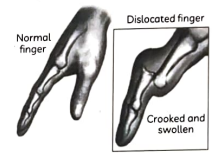
Ans. When the bones are displaced from their original position, it’s called dislocation. It is the main injury of joints. It can be managed by:
(1) Rehabilitation: This process is started after the splint or sling is removed. The purpose of designing exercises is to restore the normal range of motion and strength amounts to the joint.
(2) Immobilization: The joint should be immobilized with a sling for several weeks.
(3) Reduction: The doctor tries to prescribe Some gentle movements around the affected joint to help the bones come back into position.
(4) lce therapy: lce packs might help to relieve pain or to reduce the inflammatory swelling.
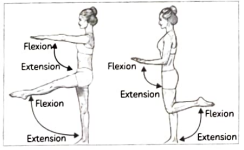
28. Define flexion and abduction with proper examples.
View AnswerAns. Flexion: It is a bending movement that decreases the angle between a segment and its proximal segment. When we flex our knee joint, the angle between our femur or upper leg and tibia/fibula or lower leg decreases.
Example: Bending the elbow, clenching a hand into a fist, tuck jump, etc.
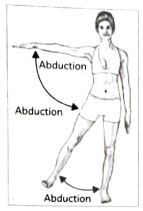
Abduction: Abduction is a movement laterally away from the middle of our body. In the case of fingers and toes, it refers to spreading the digits apart, away from the centerline of the hand or foot.
Example: Move leg or arm to the side away from the middle of body.
29. Explain motivation and its types.
View AnswerAns. The word ‘motivation’ is derived from the Latin word ‘mover, which means to change or to move. Thus, motivation is referred to change inner urge to achieve the goal. According to Alderman, motivation is the general level of arousal to action in an individual.
Motivation is of two types:
(1) Intrinsic or internal motivation
(2) Extrinsic or external motivation
(1) Intrinsic motivation: In this type of motivation, an individual gets energy or reason to do any work from within himself/ herself. This motivation may be fired by goals, simple joy, enthusiasm or needs of the body. It is a natural motivation.
(2) Extrinsic motivation: When external forces, positive or negative, produce a behavioral change. Reward, punishment, praise, blame and crash prize are examples of extrinsic motivation.
30. Explain strength and write the methods of improving strength.
View AnswerAns. Strength: It is an ability of the muscles to overcome resistance. Strength can be defined as the amount of force a muscle can exert. It is an essential component for games and sports.
Methods of improving strength:
Strength is largely developed through weight training. Weight training programs can be divided into three categories, corresponding to three types of muscle contraction: Isometric. isotonic and isokinetic.
(1) Isometric exercises: The word ‘isometric’ is derived from the Latin word ‘iso’ which means ‘same’ and ‘metric’ which means length. In isometric exercises, the force of resistance is more than the force of individual, so the movement of muscles is not visible to the third person. When these exercises are performed, muscles do not change their length, but contraction remains in muscles. E.g. Plank and side bridge, as well as the wall sit and yoga poses such as chair and tree poses.
(2) Isotonic exercises: Isotonic is derived from the Greek word ‘isos’ and ‘tonos’ which mean same tension. In this strength training exercise, the muscular group has tension along with movement. E.g. Bicep curl leg extension.
(3) Isokinetic exercises: These exercises are the combination of isometric and isotonic exercises. They are performed on special machines. E.g., Stationary bike.
SECTION – D
31. A new student, Rohan is quite interested in participating in the sports events of his new school. He has been taught the latest rules and regulations of the game of football. He learnt the biochemical aspects of the game including various movements, from the football coach.
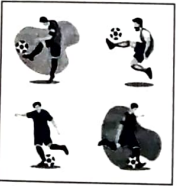
(A) The type of movement in which the angle between joint decreases is known as:
(a) Flexion
(b) Extension
(c) Gliding
(d) Sliding
View AnswerAns. (a) Flexion
(B) Straightening parts of a joint due to which the angle increases:
(a) Flexion
(b) Extension
(c) Abduction
(d) Adduction
View AnswerAns. (b) Extension
(C) Moving a part away from mid-line is:
(a) Flexion
(b) Extension
(c) Abduction
(d) Adduction
Ans. (c) Abduction
[/expand](D) Moving a part towards the mid-line is:
(a) Flexion
(b) Extension
(c) Abduction
(d) Adduction
View AnswerAns. (d) Adduction
32.
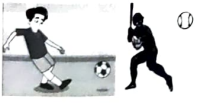
“The more force an individual exerts on the downward bounce, the higher the ball bounces into the air.” Which law is this statement referring to?
(a) Newton’s 1st law
(b) Newton’s 2nd law
(c) Newton’s 3rd law
(d) Law of gravitation
View AnswerAns. (c) Newton’s 3rd law
(B) Among the given pictures, Newton’s 3rd law is depicted in:
(a) First
(b) Second
(c) Both (a) and (b)
(d) None of these
View AnswerAns. (c) Both (a) and (b)
(C) The acceleration of an object depends directly upon the net force acting upon it and inversely upon its:
(a) Weight
(b) Mass
(c) Height
(d) Density
View AnswerAns. (b) Mass
(D) _____________ is the study of human body and various forces acting on it.
(a) Biology
(b) Biomechanics
(c) Physiology
(d) Anatomy
View AnswerAns. (b) Biomechanics
33. Test 1
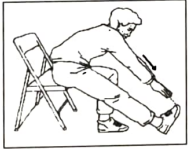
Test 2
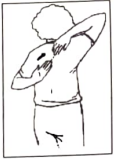
(A) From the given pictures, identify test number 1.
(a) Chair sit and reach test
(b) Back scratch test
(c) 6 min walk test
(d) Arm curl test
View AnswerAns. (a) Chair sit and reach test
(B) From the given pictures, identify test number 2.
(a) Chair sit and reach test
(b) Back scratch test
(c) 6 min walk test
(d) Arm curl test
View AnswerAns. (b) Back scratch test
(C) Pick the odd one out.
(a) Arm curl test
(b) Chair stand test
(c) 6 min walk test
(d) Partial curl up
View AnswerAns. (d) Partial curl up
(D) _________________ is the purpose of back scratch test.
(a) To measure the lower body flexibility
(b) To measure an upper arm and shoulder girdle flexibility
(c) To measure the flexibility of legs
(d) Both (a) and (c)
View AnswerAns. (b) To measure an upper arm and shoulder girdle flexibility
SECTION – E
34. What is league tournament? Explain the method to decide winner in league tournament.
View AnswerAns. League tournament: In league tournaments, all teams play against each other in a fixed number of times, irrespective of winning or losing. Points are awarded for a win, lose or draw and the winner is the one with most points after all games are played. It is very time consuming. It is also known as ‘Round Robin Tournament! Mr. Burger was the first person, who imagined about the league tournament and owing to that, it is also called burger system. In these tournaments, it is very important to determine the number of games to be played.
Method for deciding winner in a league tournament: The scoring in the league matches is done in the following way:
Winner of the Match = 2 points
Draw of Match = 1 point
Loser of the Match = 0 point
If the points are equal in case of 2 teams, the match is held again. But, if it remains a draw, the team which won maximum number of matches is declared winner. If the tie still remains, the team which ceased maximum no. of goals is declared winner. If the tie still remains, a match is held again between the 2 teams. If there is a draw, again the winner is declared by toss. Some other methods to decide the winner are discussed below.
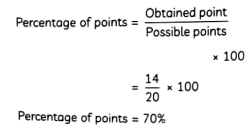
(1) British method: In this method, total obtained points are divided by the total possible points. For example, if a team has played 10 matches, and won 6 matches, lost 2 matches and 2 remain draw, the percentage of points will be:
Total obtained points = 12 + 2 = 14 Possible points = 20
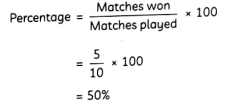
(2) American method: In this method, the number of matches won are divided by the total number of matches played. If a team plays 10 games, and wins 5 games, then:
35. Discuss the effects of exercise on muscular system.
View AnswerAns. Regular exercise causes the following effects on the muscular system:
(1) Healthy and sound body: Our body becomes balanced and flexible by doing regular exercise.
(2) Proper blood circulation: The heart pumps blood easily with exercise. As a result of exercise., blood reaches every part of the body properly and adequately and the muscles of the heart begin to function properly.
(3) Aerobic and anaerobic endurance increases: By doing exercise, the capacity of muscles to work for longer duration without fatigue is improved.
4) Increase in muscle mass: Regular exercise increases the muscle mass, i.e., increase in myoglobin content of muscles, thus controlling the weight of an individual.
5) Number of capillaries increases: By doing exercise, the number of functioning capillaries per muscle increases and therefore, the blood supply to the muscles increases.
(6) Increase in coordination: Regular exercise increases coordination in the muscles. As a result, a person does not feel fatigue even after working for a long time.
(7) Effects on bones and joints: Children’s bones happen to be very soft and fragile. Thus, the bones and muscles become strong by doing exercise. They become hard and can work for longer time. It also has effects on our joints.
(8) Helpful in old age: Old age leads to many deformities in our bods like hump in back, pain in joints, swelling, etc. But we can keep away from problems in old age if we keep on exercising regularly from a young age.
(9) Delays fatigue: Regular exercise increases muscle capacity. so less lactic acid is produced by the muscles and fatigue also decreases. Thus, muscles can work for a long time with greater efficiency.
(10) Controls extra fat: Regular exercise helps in controlling extra body fat. Exercises burn the calories which are taken in the form of fat
36. The trajectory of an object launched or projected into the air with a starting velocity is known as projectile motion. It moves in a curved direction as a result of gravity. It is referred to as a projectile.
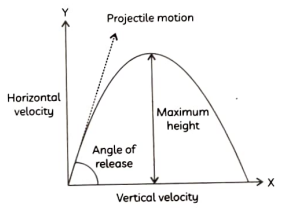
Ans. The trajectory of an object launched or projected into the air with a starting velocity is known as projectile motion. It moves in a curved direction as a result of gravity. It is referred to as a projectile.
Following are the factors that affect projectile motion:
(1) Angle of projection: The projectile’s height and range are determined by the angle at which it is launched. The optimal angle is 45 degrees to provide maximum range without air resistance. For example, a basketball player changes the shot’s angle to shoot the ball through the hoop.
(2) Height of projection: The projectile’s trajectory is influenced by the height at which it is launched. Longer ranges are often the result of higher launch points. For example, a downhill skier starting from higher altitude can achieve a greater speed and distance
(3) Air resistance: It opposes the motion of projectile, which directly affects its trajectory. More air resistance reduces the range and maximum height of the projectile. For example, a golf ball with dimples reduces air resistance, allowing it to travel a large distance.
(4) Gravity: It pulls the projectile downward. affecting its vertical motion. Its value is constant and acts in downward direction. For example, the height of a high jumper is influenced by gravity.
(5) Initial velocity: Higher initial velocity leads to a longer range and higher maximum height of a projectile. For example, a powerful volleyball serve covers a greater distance than a soft serve.
37. Explain interval training with its advantages and disadvantages.
View Answer
Ans. Interval training: This method enables the athlete to improve the work load by diversifying heavy bouts of fast running with recovery period of slower jogging. This method provides break and rest between periods of hard exercise and rest. In this method, the athlete runs hard at any distance up to 1000 meter and then has a period of easy jogging. This scientific principle of training was first introduced by Finn Paa vo Nurmi and his coach Pikhala, who recognised the relationship between work and rest. Instead of running 10-20 miles daily, Finn used to run 400-meter race 10-20 times a day. He felt, it improved his speed and endurance and he created history by winning nine gold and three silver medals in various events in the Olympic Games.
Advantages of interval training:
(1) Increases endurance, overall fitness and level of performance.
(2) More work out in lesser time.
(3) Coach can instruct and guide about his weakness in resting time.
(4) Patience of athletes improves.
(5) Progress of athletes can be measured easily.
(6) Results are evident faster.
(7) Maximum results in minimum time.
(8) Improves cardiovascular system.
(9) Engages aerobics and anaerobics.
(10) Improves repair rate of body.
Disadvantages of interval training:
(1) Increased chances of injury.
(2) Cardiac diseases may occur due to daily training.
(3) Due to toughness on the body, increased risk of overtraining.