Kindly share you feedback about the website – Click here
Class IX
Time Allowed: 3 hours Max Marks: 80
General Instructions:
- The question paper comprises four sections A, B, C and D. there are 37 questions in the question paper. All questions are compulsory.
- Section A question no 1 – 20 – all questions and parts thereof are of one mark each.
- Section B question no 21 – 26 are short answer type questions carrying 2 marks each.
- Section C question no 27 – 34 are short answer type questions, carrying 3 marks each.
- Section D question no 35 – 37 are long answer type questions carrying 5 marks each
- There is no overall choice. However, internal choices have been provided in some questions.
- Wherever necessary, neat and properly labelled diagrams should be drawn.
Section – A
1. What is a substance?
Ans. A substance is a kind of matter that cannot be separated into other kinds of matter by any physical process.
OR
What is solubility?
Ans. Solubility of a substance (solute) is the mass of the substance in grams that dissolves in 100 g of a solvent to form a saturated solution.
2. What will be the number of neutrons if an atom has mass number = 23 and the number of electrons = 11?
Ans. Number of electrons = 11
Mass number = 23
Atomic number = number of electrons = 11
Hence, number of neutrons
= mass number – atomic number
= 23 – 11 = 12
3. Arun has prepared 0.01% (by mass) solution of sodium chloride in water. Which of the following correctly represents the composition of the solution?
(A) 1.00 g of NaCl + 100 g of water
(B) 0.11 g of NaCl + 100 g of water
(C) 0.01 g of NaCl + 99.99 g of water
(D) 0.10 g of NaCl + 99.90 g of water
Ans. (C) 0.01 g of NaCl + 99.99 g of water
Mass% = Mass of solute x 100/(Mass of solute + Mass of solvent)
= 0.01/(0.01 + 99.99) x 100
0.01/100 x 100 = 0.01%
4. Rakesh tries to push a box on a rough floor but is unable to move it. Name the force which balances the force applied by him.
Ans. Force of friction
5. What is an electron? Who discovered it?
Ans. Electron is a negatively charged particle present outside the nucleus of an atom. It was discovered by J. J. Thomson in 1897
6. List the constituents of plasma membrane.
Ans. Lipids and Proteins.
OR
What is the function of vacuoles?
Ans. Vacuoles provide turgidity and rigidity to the cell.
7. State True or False: An atom has equal number of electrons and neutrons.
Ans. False. An atom has equal number of electrons and protons.
8. State one point of difference between xylem and phloem.
Ans. Xylem conducts water in the plant body. Phloem transports food in the plant body
9. Name: (i) the cells which have changing shape,
Ans. Amoeba
(ii) the cells which have a typical shape.
Ans. Nerve cell
OR
Name the process by which unicellular freshwater organisms and most plant cells tend to gain water.
Ans. Endosmosis. When cell is kept in hypotonic solution, it will gain water.
10. Name the main constituent substance present in plant cell wall and state its function.
Ans. Cellulose. It provides structural strength to plant.
11. A force is applied on a metal block lying on floor in one direction still the block does not move. Name the force which is balancing it.
Ans. Force of friction between metal surface and floor
OR
Which law of motion can best describe the following:
Shoulder bone fracture from recoil of a gun.
Ans. Newton’s III law of motion
12. Name the physical quantity that measures inertia. State its SI unit.
Ans. Mass. SI unit is kg.
OR
Give reason: Luggage placed on the roof of a car or bus is tied with rope.
Ans. This is done to prevent luggage from falling when the vehicle is suddenly stopped or started because due to inertia the luggage will experience a jerk in a direction opposite to the direction of vehicle.
13. Identify the kind of motion in the following case:
An electron orbiting around nucleus.
Ans. Uniform circular motion.
14. Name the two types of manure on the basis of the kind of biological material involved.
Ans. (i) Compost and vermicompost.
(ii) Green manure.
For question numbers 15, 16 and 17, two statements are given- one labelled Assertion (A) and the other labelled Reason (R). Select the correct answer to these questions from the codes (a), (b), (c) and (d) as given below:
(A) Both A and R are true, and R is correct explanation of the assertion.
(B) Both A and R are true, but R is not the correct explanation of the assertion.
(C) A is true, but R is false.
(D) A is false, but R is true.
15. Assertion (A): Chloroplast performs photosynthesis.
Reason (R): Chloroplast comprises photosynthetic pigments.
(A) Both A and R are true, and R is correct explanation of the assertion.
(B) Both A and R are true, but R is not the correct explanation of the assertion.
(C) A is true, but R is false.
(D) A is false, but R is true.
Ans. (A) Both A and R are true, and R is correct explanation of the assertion.
Chloroplast is involved in the process of photosynthesis. It comprises a photosynthetic pigment called chlorophyll, which traps energy from the Sun.
16. Assertion (A): Rhinoceroses communicate using infrasound of frequency.
Reason (R): Sound of frequency above 20 Hz is called infrasound.
(A) Both A and R are true, and R is correct explanation of the assertion.
(B) Both A and R are true, but R is not the correct explanation of the assertion.
(C) A is true, but R is false.
(D) A is false, but R is true.
Ans. (C) A is true, but R is false.
Rhinoceroses communicate using infrasound frequency which is below 20Hz
OR
Assertion (A): No sound is heard when a simple pendulum oscillates in air.
Reason (R): A vibrating body produces sound.
(A) Both A and R are true, and R is correct explanation of the assertion.
(B) Both A and R are true, but R is not the correct explanation of the assertion.
(C) A is true, but R is false.
(D) A is false, but R is true.
Ans. (B) Both A and R are true, but R is not the correct explanation of the assertion.
A sound is heard only if the body vibrates with a frequency more than 20 Hz and less than 20,000 Hz. The pendulum oscillates with a frequency less than 20 Hz. Hence, no sound is heard.
17. Assertion (A): Collenchyma allows easy bending in various parts of a plant mainly young growing stem without breaking them.
Reason (R): Collenchyma is a mechanical tissue in young dicotyledonous stems and provides great tensile strength with flexibility to those organs in which it is found.
(A) Both A and R are true, and R is correct explanation of the assertion.
(B) Both A and R are true, but R is not the correct explanation of the assertion.
(C) A is true, but R is false.
(D) A is false, but R is true.
Ans. (A) Both A and R are true, and R is correct explanation of the assertion.
Collenchyma is a mechanical tissue in young dicotyledonous stems and provides great tensile strength with flexibility to those organs in which it is found. It allows easy bending in various parts of a plant mainly young growing stem without breaking them.
Q. No 18-20 contain five sub-parts each. You are expected to answer any four sub parts in these questions.
18. Read the following and answer any four questions from 18 (i) to 18 (v).
Study the given passage and answer the following questions.
The following diagram shows that a simple pendulum consisting of a bob of mass 100 gm. Initially the bob of the pendulum is at rest at ‘O’. It is then displaced to one side at A. The height of ‘A’ above ‘O’ is 5 cm. (Take g = 10 m/s2)
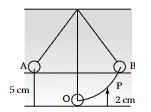
(i) What is the value of potential energy of bob at ‘A’ and where does it come from?
Ans. PE = mgh = 0.1 × 10 × 5 × 10–2 = 0.05 J
The work done in raising the bob through a height of 5 cm (against the gravitational attraction) gets stored in the bob in the form of its potential energy.
(ii) What is the value of total energy of the bob at position A?
Ans. At position A, PE = 0.05 J, KE = 0
So, Total energy = 0.05 J
(iii) What is the value of kinetic energy of the bob at mean position ‘O’?
Ans. At mean position, potential energy is zero, hence KE at O = 0.05 J
(iv) What is the value of kinetic energy and potential energy of the bob at the position ‘P’ whose height above O is 2 cm?
Ans. PE at P = mgh = 0.1 × 10 × 2 × 10–2 = 0.02 J
K.E = Total energy – PE = 0.05 – 0.02 = 0.03 J
(v) What is kinetic energy?
(A) Energy acquired due to motion
(B) Energy acquired due to rest
(C) Sum of potential and mechanical energy
(D) It is the energy stored inside a body.
Ans. (A) Energy acquired due to motion
Kinetic energy is the energy an object has because of its motion
19. Study the given diagram and answer any four question from 19 (i) to 19 (v)
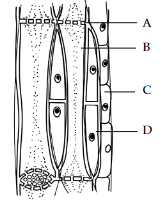
(i) Name the tissue shown in the diagram.
Ans. The given diagram is of phloem.
(ii) What will happen if Phloem at the base of the branch is removed?
Ans. If the phloem at the base of branch is removed, then lower area of the branch will not receive food from the leaves. But the plant will not die, as it will continue to receive food from other branches as food can move in phloem in both direction.
(iii) Identify the parts A,B,C and D.
(A) A- Companion cell, B – Sieve tube, C – Sieve plate, D- Phloem parenchyma
(B) A-Phloem Parenchyma, B- Companion cell, C – Sieve tube, D- Sieve plate
(C) A- Sieve plate, B – Sieve tube, C – Phloem parenchyma D- Companion cell
(D) A – Sieve tube, B – Phloem parenchyma, C – Sieve plate, D- Companion cell
Ans. (C) A- Sieve plate, B – Sieve tube, C – Phloem parenchyma D- Companion cell
In the given diagram, label A represents sieve plate, B is sieve tube, C is phloem parenchyma and label D represents the companion cell.
(iv) What are vascular bundles?
Ans. Vascular bundles consist of xylem and phloem.
(v) What are the types of complex permanent tissues?
Ans. Xylem and phloem.
20. Read the following and answer any 4 questions from 20 (1) to 20 (v).
The teacher instructed three students A, B and C respectively to prepare a 50 % (mass by volume) solution of sodium hydroxide. ‘A’ dissolved 50 g of NaOH in 100 mL of water, ‘B’ dissolved 50 g of NaOH in 100 g of water while ‘C’ dissolved 50 g of NaOH in water to make 100 mL of solution.
(i) Which one of the following has made the desired solution?
Ans. Student C has made desired solution by dissolving 50 g NaOH in water to make the volume of the solution 100 mL
(ii) Define concentration of a solution.
Ans. It indicates the exact amount of solute dissolved in an exact amount of solvent or solution.
(iii) How will you prepare a 10% solution of sugar?
(A) Dissolve 90 g of sugar in 10 g of water.
(B) Dissolve 10 g of sugar in 10 g of water.
(C) Dissolve 100 g of sugar in 100 g of water.
(D) Dissolve 10 g of sugar in 90 g of water.
Ans. (D) Dissolve 10 g of sugar in 90 g of water.
Dissolve 10 grams sugar in 80 ml water. After the sugar is completely dissolved, adjust the volume to 100 ml. 10% sugar and 90% water by mass.
(iv) The two components of a solution are___________ and _____________
(A) The two components of a solution are solute and solvent.
(B) The two components of a solution are mixture and solvent.
(C) The two components of a solution are compound and mixture.
(D) The two components of a solution are solute and water always.
Ans. (A) The two components of a solution are solute and solvent.
Ans. Solutions are made up of two parts a solvent and a solute.
(i) The component that dissolves the other component is called the solvent.
(ii) The component that is dissolved in the solvent is called solute.
(v) Name the solute and solvent in the above solution.
Ans. Sodium hydroxide, NaOH is the solute and water is the solvent.
Section – B
21. What do you understand by the term acceleration? What is meant by its being positive or negative?
Ans. Acceleration of a body is defined as the rate of change of its velocity with time.
Acceleration = Change in velocity/Time taken for change
The acceleration is taken to be positive if it is in the direction of velocity. Example: a bus moving with increasing speed.
OR
(i) Give one example of a body whose average velocity is zero.
Ans. When the body returns back to initial point, e.g., when an athlete returns back to starting point, his average velocity is zero.
(ii) Give one example of a body whose average speed is zero.
Ans. Average speed of a moving body can never be zero.
22. Name the living component common to both the complex permanent tissues found in plants. What is its function?
Ans. Living component common to xylem and phloem tissues is parenchyma. Its function is to store food and help in sideways conduction of water in xylem and food in phloem.
23. Calculate the molar mass of the following substances:
(Given atomic masses of C = 12 u, H=1u, 5 = 32 u, O= 16 u)
(i) Ethyne, C2H2
Ans. Ethyne, (C2H2) = 2 × 12 + 2 × 1 = 24 + 2 = 26 u
(ii) Sulphur molecule, S8
Ans. Sulphur molecule (S8) = 8 × 32 = 256 u
OR
What are valence shell and valence electrons?
Ans. Valence shell is the outermost shell in an atom. The electrons present in it are called valence electrons.
24. State reason for the following statements:
(i) Ceilings of good conference halls and concert halls are curved.
Ans. Because sound after reflection reaches evenly to the entire hall.
(ii) Sound waves are mechanical waves.
Ans. Because they need material medium to travel.
25. Define the terms (a) isotope,
Ans. The atoms of same element having same atomic number, but different mass numbers are called isotopes. e.g., 1H1, 1H2, 1H3 (any other example)
(b) isobar giving one example of each.
Ans. The atoms of different elements with same mass number and different atomic numbers are called isobars. e.g., Calcium (atomic number 20) and argon (atomic number 18) with same mass number 40
OR
List the observations in a-particle scattering experiment which led Rutherford to make the following conclusions:
(i) Most of the space in an atom is empty.
Ans. Most of the alpha-particles passed through the gold foil without getting deflected.
(ii) Whole mass of an atom is concentrated in its centre.
Ans. Very few particles were deflected from their path by 180°, indicating that whole mass of the atom is present at its centre.
26. Why storage of grains leads to losses? What preventive and control measures are adopted before grains are stored for future use?
Ans. Due to biotic factors like insects, rodents, fungi, mites, bacteria and abiotic factors like inappropriate moisture and temperature in the place of storage, there is degradation in quality, loss in weight, poor germinability, discolouration of produce, all leading to poor marketability.
So, preventive and control measures are used before grains are stored for future use, which include strict cleansing of the produce before storage, proper drying of the produce first in sunlight and then in shade and fumigations by using chemicals that kill pests.
Section – C
27. (i) Name the tissue in the following figure:
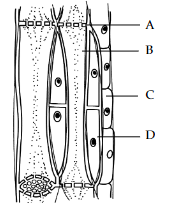
Ans. Phloem
(ii) Identify the parts ‘A’, ‘B’, ‘C’ and ‘D’.
Ans. ‘A’–Sieve plate, ‘B’–Sieve tube, ‘C’–Phloem parenchyma, ‘D’–Companion cell.
OR
(i) Name the following:
(a) Tissues that connect muscles to bone.
Ans. Tendon
(b) Tissues that store fat in our body.
Ans. Adipose tissue
(c) Tissues that transport food in plants.
Ans. Phloem
(d) Tissues that provide flexibility in plants.
Ans. Collenchyma
(ii) List the role of cork in plants.
Ans. (a) It prevents loss of water by evaporation.
(b) It protects plant from the invasion of parasites and harmful micro-organisms.
28. When is the work done by a force said to be negative? Give one situation in which one of the forces acting on the
object is doing positive work and the other is doing negative work.
Ans. Negative work: When the force is acting opposite to the direction of the displacement, the work done by the force is said to be negative. When we lift an object, two forces act on the object:
(i) Muscular force: Doing positive work in the direction of the displacement.
(ii) Gravitational force: Doing negative work opposite to the direction of the displacement.
29. (i) Why are the wheels of vehicle provided with mud guards?
Ans. Due to inertia of motion, wheels rotate at high speed and mud sticking to the wheel flies off tangentially
(ii) A cricket player lowers his hand while catching a ball. Why?
Ans. This increases the time of catching, decreases the acceleration of the ball, hence force exerted on the hands decreases
(iii) Why does a glass pane of a window gets shattered when a flying pebble hits it?
Ans. High velocity of pebbles, decreases to zero in a very short interval of time for which it remains in contact with glass pane and shatters the glass pane.
OR
Explain an activity to show that, during a free fall heavier and lighter objects accelerate at the same rate.
Ans. Drop two balls with different mass from a tall building at the same time. They will reach the ground at the same time. Both the balls are at free fall and their initial velocity is same that is zero. As you know that, s = ½ at2. , so the only way that they touch the ground at the same time is that acceleration is same for both the balls. This experiment proves that during free fall objects accelerate at the same rate, irrespective of their mass.
30. How would you arrive at a mathematical formula to measure force using second law of motion? Define the unit of force using this formula.
Ans. If a body of mass (m), moving at velocity (u) accelerates uniformly at (a), time (t), so that its velocity changes to v, then
Initial momentum p1 = mu
Final momentum p2 = mv
Change in momentum = p2 – p1
= mv – mu
= m (v – u)
According to second law of motion,
force F ∝ change in momentum/time
F ∝ (p2 – p1)/ t
We know that, F ∝ m (v – u)/t
∴ a = (v – u)/t
F ∝ ma
F = kma
Here k = 1
Thus, F = ma
S.I. unit of force, Newton is equal to kg – m/s2.
One Newton force is exerted on an object of mass 1 kg to produce an acceleration of 1 m/s2 in it.
31. Write the chemical symbols of the following elements: Gold, Copper, Potassium, Silver, Platinum and Iron.
Ans. Gold = Au, Copper = Cu, Potassium = K, Silver = Ag, Platinum = Pt, Iron = Fe.
32. Make a labelled diagram to highlight two differences between striated and cardiac muscles. Write one function of striated muscles in our body.
Ans.
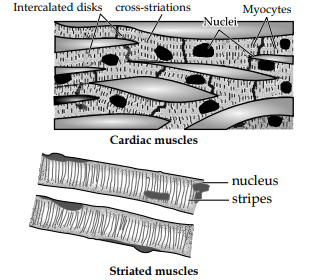
Function: Striated muscles help in body movement
33. Based on the kind of biological material used, list two kinds of manures. How are they prepared?
Ans. (i) Compost and vermi compost.
(ii) Green manure.
Compost and vermicompost: The process in which farm waste material, vegetable waste, animal refuse, domestic waste, sewage waste, straw, eradicated weed, etc. are decomposed in pits. It is rich in organic matter and nutrients. Compost is also prepared by using earthworms to hasten the process of decomposition of plant and animal refuse. This is vermicompost.
Green manure: Prior to the sowing of the crop seeds, some plants like sun hemp or guar are grown and then mulched by ploughing. It helps in enriching the soil with nitrogen and phosphorus.
34. Give a reason to explain why:
(a) isotopes of an element show identical chemical properties?
Ans. Since all the isotopes of an element have identical electronic configuration containing the same number of valence electrons. Therefore, all the isotopes of an element show identical chemical properties.
(b) the atomic masses of elements are in fractions?
Ans. The fractional atomic masses of elements are due to their isotopes having different masses.
(c) atoms combine with other atoms
Ans. The atoms combine with other atoms to achieve the electronic configuration of the nearest noble gas and thus, become more stable.
Section – D
35. (a) Differentiate between average velocity and average speed.
Ans. The average speed of an object is obtained by dividing the total distance travelled by the total time taken while average velocity is given by the displacement at a given period of time.
(b) A car is moving along a straight-line OP as shown below. It moves from O to P in 18 s and returns from P to Q in 6 s. What are the average velocity and average speed of the car in going (i) from O to P (ii) from O to P and back to Q.

Ans. (i) Average velocity = total displacement/total time
= 360/18
= 20 m/s
Average speed = total distance covered/total time
= 360/18
= 20 m/s
(ii) Average velocity = 240 / 24 = 10 m/s
Average speed = 480 / 24 = 20 m/s
OR
(i) Derive the equation of motion, s = ut + at2 by graphical method.
Ans. Let us consider that the object has travelled a distance s in time t under uniform acceleration a.
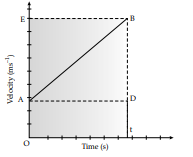
As in the graph, the distance travelled by the object is obtained by the area enclosed within OABC under the velocity-time graph AB.
Thus, the distance s travelled by the object is given by
s = area OABC (which is trapezium) = area of the rectangle OADC + area of the triangle ABD
= OA × OC + 1/2 (AD × BD)
Substituting OA = u, OC = AD = t
and BD = at, we get
s = u × t + ½(t × at)
or s = ut + 1/2at2
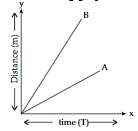
(ii) Which of the two bodies A and B in the following graph is moving with higher speed and why?
Ans.
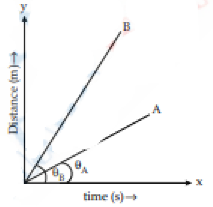
Speed of the body is directly proportional to q. Larger the value of q, the greater is the speed of the body. Thus, B moves with higher speed.
36. (i) If 18 gm of pure water is electrolysed, 2 gm of hydrogen and 16 gm of oxygen is obtained. Which law of chemical combination is illustrated by this statement?
Ans. Law of constant proportion
(ii) State the law of constant proportion. Illustrate with the help of an example.
Ans. A compound prepared by any method contains the same elements in the fixed ratio by mass. For example, H2O contains hydrogen and oxygen in the ratio 2 : 16 i.e., 1 : 8 by mass.
(iii) Which postulate of Dalton’s atomic theory is the result of law of conservation of mass?
Ans. Atoms can neither be sub-divided, created nor destroyed.
(iv) Which point of Dalton’s atomic theory came from law of constant proportions?
Ans. Atoms of different elements combine in simple whole number ratios to form chemical compound.
37. How do respiratory gases move in and out of the cell? Taking the example of photosynthesis explain how the exchange of gases takes place. What is the composition of plasma membrane?
Ans. Diffusion.
Conc. of CO2 is more in air as compared to cell so it moves in. O2 is produced in photosynthesis thus conc. of O2 is higher in cell so it moves out. Plasma membrane made up of proteins +lipids
OR
(i) Explain the terms:
(a) Endocytosis,
Ans. Endocytosis: The flexibility of the cell membrane enables the cell to engulf food and other materials from its external environment. Such process is known as endocytosis.
(b) Plasmolysis
Ans. Plasmolysis: When a living plant cell loses water through osmosis, there is shrinkage or contraction of the contents of the cell away from the cell wall. This phenomenon is known as plasmolysis.
(ii) What will happen if the organisation of a cell is damaged due to certain physical or chemical reasons?
Ans. When the organisation of a cell gets damaged, lysosomes will burst and their enzymes will eat up their own cell organelles. Therefore, lysosomes are also known as the suicidal bags of the cell.
(iii) How do substances like CO2 and water move in and out of the cell?
Ans. Gases like CO2 and O2 move in and out of the cell by diffusion from their higher concentration to lower concentration. Water enters the cell by endosmosis through semi-permeable plasma membrane from its higher concentration to lower concentration.