Our Environment
Our Environment
1. Which will get more energy, secondary consumers or tertiary consumers?
View AnswerAns. Secondary consumers will get more energy.
2. List two natural ecosystems.
View AnswerAns. (i) Oceans, (ii) forests are two natural ecosystems.
3. List two biotic components of environment.
View AnswerAns. Plants, animals, micro-organisms (any two) are biotic components.
4. Why are green plants called producers?
View AnswerAns. Green plants prepare their own food by photosynthesis with the help of CO2, H2O, sunlight and chlorophyll.
5. Why do producers always occupy first trophic level of food chain?
OR
The first trophic level in a food chain are always occupied by green plants, why?
View AnswerAns. They prepare their own food from CO2, H2O and sunlight from environment. They are consumed by herbivores; therefore, they always occupy first trophic level.
6. Which of the following are always at second trophic level of food chains?
Carnivores, Autotrophs, Herbivores.
View AnswerAns. Herbivores will always be at second trophic level.
7. What will be the amount of energy available to the organisms of secondary consumer trophic level of food chain, if the energy available to producer level is 10000 Joules.
View AnswerAns. Energy available to primary consumer’s level is 10000 X 10/100 = 1000 J
Energy available to secondary consumer trophic level = 10 1000 100 × = 100 J
8. The following organisms form a food chain. Which of these will have the highest concentration of non-biodegradable chemicals? Name the phenomenon.
Insects, Hawk, Grass, Snake, Frog.
View AnswerAns. Hawk is a decomposer and have maximum concentration of non-biodegradable chemicals. The phenomenon is called Biomagnification.
9. Select two non-biodegradable substances from the following waste generated in the kitchen:
Spoil food, Paper bags, Milk, Tea bags, vegetable peels, tin cans, used tea leaves.
View AnswerAns. Tea bags and tin cans.
10. What are various steps in the food chain called?
View AnswerAns. Trophic level.
11. Why are bacteria and fungi called decomposer?
View AnswerAns. Bacteria and fungi are called decomposer because they breakdown complex organic matter as remains of plants and animals into CO2, methane and other simple molecules which go into atmosphere and as nutrients to soil.
12. Consider the following food chain which occurs in forest: Grass → Deer → Lion If 10000 J of solar energy is available to grass, how much energy would be available to deer to transfer to lion.
View AnswerAns. Grass will absorb 1% solar energy i.e. 10000 × 1/100 = 100 J
Dear will get 10% of 100 J = 100 × 10/100 = 10 J
Out of this 10 J of energy, only 1 J of energy can be transferred to lion.
13. In a food chain of frog, grass, insect and snake, assign trophic level to frog.
View AnswerAns. Grass → Insect → Frog → Snake
Frog is a secondary consumer and belongs to 3rd trophic level.
14. Give one protective function of forests.
View AnswerAns. Forests help to reduce air pollution.
15. What will be the amount of energy available to the organisms of 2nd trophic level of food chain if energy available at the first trophic level is 1000 J.
View AnswerAns. 1000 × 1/10 = 100 J.
16. Write the appropriate names of trophic level ‘Z’ and ‘X’ in the figure given below.
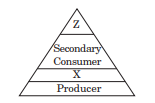
Ans. ‘X’ is primary consumer, ‘Z’ is tertiary consumer in the given figure.
17. State a way to prevent accumulation of harmful chemicals in our bodies
View AnswerAns. Minimum use of fertilizers, insecticides and pesticides, can prevent the accumulation of harmful chemicals in our body.
18. During heavy rain in a village the rain water carried excessive fertilizer to a pond. How will it affect the fish production in pond in the long run?
View AnswerAns. Fish production will decrease due to formation of excess of algae.
19. “Flow of energy is unidirectional”. Name the first two components of the environment involved in flow of energy from the Sun.
View AnswerAns. Producers and primary consumers are first two components in the flow of energy.
20. Define ecosystem.
OR
What is an ecosystem?
View AnswerAns. All living organisms and abiotic components of surroundings forms an ecosystem.
21. Draw a food chain which operates in forest ecosystem.
View AnswerAns. Grass → Deer → Tiger.
22. What is depicted in the below mentioned scheme?
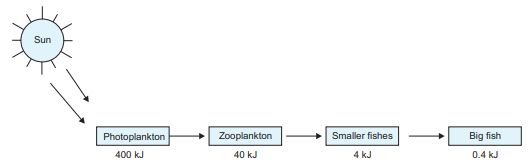
Ans. It depicts 10% law in food chain for energy transfer from one trophic level to another.
23. List two man-made ecosystem.
View AnswerAns. Aquarium, crop land, park.
24. Why are plastics non-biodegradable substances?
View AnswerAns. It is because plastics are not decomposed by micro-organisms. (Note: Now, plastic eating enzymes has been discovered).
25. Consider a food chain consisting of wheat, rat, snakes, peacock. What will happen if all snakes are killed?
View AnswerAns. The peacock will also die. The population of rats will increase.
26. Change one consumer each that belongs to the second and third trophic levels from the following organisms : Eagle, frog, tiger, rabbit, fox
View AnswerAns. (i) Second trophic level → Rabbit (ii) Third trophic level → Frog and fox.
27. In the following food chain, 100 J of energy is available to the lion. How much energy was available to the producer? Plants → Deer → Lion
View AnswerAns. Plants → Deer → Lion
It is given that 100 J of energy is available to lion.
Let the amount of energy available to deer be x Joules.
According to 10% law, 10% energy from deer must have been transferred to lion. So, energy available to deer can be calculated as, 10/100 × X = 100 J, Therefore, x = 1,000 J
Now, let the amount of energy available to plants be y Joules.
According to 10% law, 10% energy from plants must have been transfered to deer. So, energy available to plant can be calculated as, 10/100 × y = 1,000 J
Therefore, y = 10,000 J
So, we have found that energy available to the producer is 10,000 J.
28. In the following food chain, 10 J is energy available to the hawks. How much energy would have been present for the rats? Plants → Rats → Snakes → Hawks
View AnswerAns. 1000 J.
29. List two steps that should be taken for the maintenance of healthy environment.
View AnswerAns. (i) Controlling pollution (ii) Afforestation (iii) Proper Waste Disposal
30. What is the functional unit of environment?
View AnswerAns. Ecosystem is the functional unit of environment.
31. Why are some substances biodegradable and some are non-biodegradable?
View AnswerAns. Biodegradable substances are those which are broken by micro-organisms and get decomposed. They do not persist in environment for a very long time e.g., paper. Non-biodegradable substances are those which are not broken by micro-organisms. They persist in environment for long time. e.g. plastic, DDT.
32. Define trophic level. Name the first trophic level.
View AnswerAns. Each level in a food chain is called trophic level. First trophic level is producers.
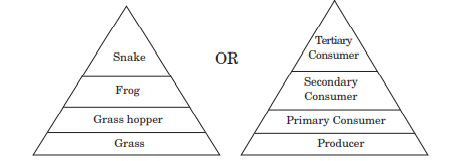
33. Give an example of food chain and state the different trophic levels in it
View AnswerAns. An example of food chain is grassland food chain. Its different trophic levels are shown in the given figures
34. What is the role of decomposers in the ecosystem?
View AnswerAns. (i) Decomposers decompose the remains of plants and animals.
(ii) They clean the environment.
(iii) They bring back the raw materials to environment.
35. Compare the advantages of cloth bags over polythene bags
View AnswerAns. (i) Cloth is biodegradable, does not pollute environment.
(ii) It can be used again like plastic bag and moreover it is eco-friendly.
36. Accumulation of harmful chemicals in our body can be avoided. Explain how this can be achieved.
View AnswerAns. (i) Wash vegetables and fruits with saline water and vinegar.
(ii) Shock the vegetables in salt water for few minutes before cooking.
(iii) Boil the vegetables.
(iv) Organic manure and organic eco-friendly pesticides should be used.
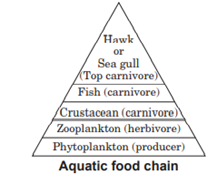
37. Construct an aquatic food chain showing four trophic levels.
View AnswerAns.
38. Energy flow is unidirectional in food chain? Explain.
View AnswerAns. The energy of sun is taken by plants and cannot be given back. Herbivore eat plants and cannot give back energy to plants. Carnivores eat herbivores and cannot give back energy to herbivores. It means flow of energy is unidirectional from lower trophic level to higher trophic level.
39. (a) What is an ecosystem? List its two main components.
View AnswerAns. Ecosystem is composed of different organisms interdependent upon each other. Biotic and abiotic components are its two main components.
(b) We do not clean ponds or lakes, but an aquarium needs to be clean regularly, explain.
View AnswerAns. Pond or lake is a natural ecosystem; several organisms present in it maintain a balance in the ecosystem. Aquarium is an artificial ecosystem in which bacteria convert fish food into ammonia which is harmful for fish. Water needs to be changed regularly. Chlorine water should be dechlorinated otherwise fish will not survive. Air pump is needed to provide oxygen. Artificial ecosystem need utmost care to remain stable.
40. What will happen if we kill all the organisms in one trophic level?
View AnswerAns. If we kill the organisms in one trophic level.
(i) The population of organisms in previous trophic level will increase.
(ii) The population of organisms in next trophic level may decrease.
(iii) It will cause an ecological imbalance in the food chain.
41. What is meant by food chain? ‘The number of trophic levels in food chain is limited.’ Give reason to justify the statement.
View AnswerAns. Food chain is a sequence in which nutrients, food and energy is transferred in systematic way. Lower trophic level has maximum population because energy is available in more extent.
Primary consumers get 10% of energy of producers.
Secondary consumers get 10% of energy of primary consumers.
Tertiary consumers get 10% of energy of secondary consumers i.e. very less energy is available, that is why the trophic levels are limited. Tiger population is decreasing day by day as food is not easily available for them and forests are decreasing due to cutting of trees.
42. (i) Create a terrestrial food chain depicting four trophic levels.
View AnswerAns. A terrestrial food chain depicting four tropic levels is shown in diagram.
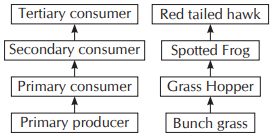
(ii) Why do we not find food chains of more than four trophic levels in nature?
View AnswerAns. According to the 10% law, the amount of energy available will not be sufficient for the survival of the organisms in the 5th trophic level. (A flow chart or a diagrammatic representation showing all the four tropic levels would also be accepted).
According to the 10% law, the amount of energy available will not be sufficient for the survival of the organism in the 5th trophic level.
43. How will you create an artificial aquatic ecosystem, which is self-sustainable?
View AnswerAns. • Take a large jar filled with water, oxygen, food and aquatic plants and animals.
• Oxygen/oxygen pump.
• Fish food.
• Aquatic plants/Producers provide O2 during photosynthesis.
• Aquatic animals/Consumers release CO2 for the process of photosynthesis.
• Decomposers are also important for natural cleaning of the aquarium.
44. (a) Construct a terrestrial food chain comprising four trophic levels.
View AnswerAns. Level 1 Plants and algae
Level 2 Herbivores like goat, cow
Level 3 Carnivores like fox, wild cat, mongoose
Level 4 large carnivores, lion, tiger
(b) What will happen if we kill all the organisms in one trophic level?
View AnswerAns. If we kill all organisms in one trophic level, then transfer of energy as well as matter to next higher level will stop, it will lead to overpopulation at one particular level, disturb the food chain and cause collapse of ecosystem.
(c) Calculate the amount of energy available to the organisms at the fourth trophic level if the energy available to the organisms at the second trophic level is 2000 J.
View AnswerAns. Energy available at second trophic level of 2000 J
Energy available at third trophic level is 2000 × 1/10 = 200 J
Energy available at fourth trophic level is 200 × 1/10 = 2 J
45. Which of the following are not biodegradable: Wool, glass, silver foil, leather?
View AnswerAns. Glass, silver foil.
46. What is full form of CFC and UNEP?
View AnswerAns. CFC stands for Chloroflurocarbon
UNEP stands for United Nations Environment Programme.
47. Name the radiations that are absorbed by ozone layer?
View AnswerAns. UV radiations (Ultra-Violet radiations) are absorbed by ozone layer.
48. Why is excessive use of CFC a cause of concern?
View AnswerAns. CFC will deplete ozone layer which prevents UV radiation to reach earth. It causes skin cancer.
49. Name the gases which have replaced CFCs.
View AnswerAns. (i) HFCs (Hydrofluorocarbons), (ii) Perfluorocarbons (PFCs) have replaced CFCs.
50. Ozone is deadly poisonous, still it performs an essential function. How?
View AnswerAns. It protects earth from harmful UV radiations.
51. Why should bio-degradable and non-biodegradable wastes discarded into separate dust bins?
View AnswerAns. It saves time and energy by separating them and waste disposal can be done in right way in minimum time.
52. Name any two items which can be easily recycled but are generally thrown in the dust-bin by us.
View AnswerAns. (i) Bits of paper (ii) Plastic bottles of water or cold drinks.
53. List two causes of depletion of ozone layer. Mention any two harmful effects of depletion of this layer.
View AnswerAns. Two causes of depletion of ozone layer are: (i) CFCs (ii) Aerosols
Two harmful effects of depletion of this layer are:
(i) UV radiations can reach the earth and causes skin cancer, harmful to eyes and immune system will be disturbed.
(ii) It may lead to variations in rainfall, ecological disturbance.
54. When the government banned the use of polybags in Delhi, the vegetable grocers found it difficult as it affected their sales. The market committee held a meeting and decided to spread awareness about harmful effect of polybags.
(i) How will you convince people that plastics are harmful to the environment?
View AnswerAns. They need to be told that cows and other animals eat polythene which is fatal for them. Coloured polythene is also very harmful for vegetables and fruits.
(ii) What alternatives of polythene bags do we have, which are environment friendly?
View AnswerAns. Paper bags, jute bags, bags of biodegradable materials are eco-friendly and carrying your own shopping bag is also more convenient.
(iii) Not many people in Delhi have stopped using polythene bags even though they are officially banned. How can schools inoculate environmental values in students?
View AnswerAns. Schools must teach students to protect environment. They should make paper bags and distribute to small shopkeepers regularly so that gradually their habits will change.
55. (i) What is the height of ozone from the equator?
View AnswerAns. 10 to 16 km
(ii) Name the rays against which ozone layer provides protection.
View AnswerAns. UV rays
(iii) Name one effect of depletion of ozone layer
View AnswerAns. Global warming.
56. (a) Water is an elixir of life, a very important natural resource. Your Science teacher wants you to prepare a plan for a formative assessment activity, “How to save water, the vital natural resource”. Write any two ways that you will suggest to bring awareness in your neighbourhood, on ‘how to save water’.
View AnswerAns. Water is one of the most precious natural resources that has vital importance in our lives. It is an essential component of the human body and is used almost everywhere in our day-to-day activities, such as cooking, washing, in agriculture and industries. It is an indispensable part of our life, without which the life on earth is not possible. However, the amount of fresh water available for sustaining life is very less. So, it is very important to conserve water. For creating awareness among people, we can adopt the following two ways.
(i) Door to door campaigning. (ii) Nukkad Nataks
(b) Name and explain any one way by which underground water table does not go down further.
View AnswerAns. Underground water table can be recharged through rainwater harvesting. Rainwater harvesting is a process by which rain water is collected and stored for the purpose of recharging the ground water or for future use like for irrigation and agriculture, for livestock, etc. In India, rainwater harvesting is an old tradition, which is followed till now in many parts of India. For example, bawris are traditional architectural rainwater harvesters that were built for collecting water, in the state of Rajasthan.
There are two ways of rainwater harvesting:
(i) Surface runoff harvesting: In urban areas, rain water that flows away from the surface can be collected and used for various purposes.
(ii) Rooftop rainwater harvesting: The rainwater on the roofs of the buildings is collected through canals that drains the water into ground water reservoirs. This stored water can later be utilised.
57. (a) Complete the following table:

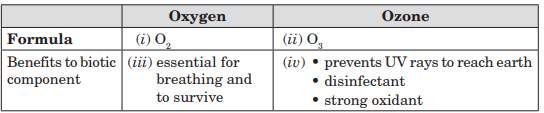
(b) How is ozone formed at the higher levels of atmosphere?
View AnswerIt is formed by action of UV light on oxygen.

58. (a) Improvement in our lifestyle has resulted in greater amount of waste generation. Suggest one change we can incorporate in our lifestyle in order to reduce non-biodegradable waste.
View AnswerAns. (i) More use of disposable items like paper plates, plastic and polythene which are recyclable.
(ii) Change in packaging Suggestion. Reuse of plastic containers
(b) The following organisms form a food chain: Insect, Hawk, Grass, Snake, Frog Which of these will have highest concentration of non-biodegradable chemicals? Name the phenomenon.
View AnswerAns. Hawk will have highest concentration of non-biodegradable chemicals. This process is called biomagnification.
59. Differentiate between biodegradable and non-biodegradable substances with the help of one example each. List two changes in habit that people must adopt to dispose of non-biodegradable waste for saving the environment.
View AnswerAns.

Two habits to dispose of non-biodegradable wastes are:
(i) Use of separate dustbins for biodegradable and non-biodegradable wastes,
(ii) Reuse of things such as polybags, etc.,
(iii) Recycling of wastes
(iv) Use of cotton /jute bags for carrying vegetables etc.
60. What is ozone? How and where is it formed in the atmosphere? Explain how it affects an ecosystem.
OR
What is ozone and how does it affect any ecosystem?
View AnswerAns. Ozone is a molecule containing three atoms of oxygen (O3). It is a highly poisonous gas present in the upper layers of the atmosphere.
Formation of ozone: The UV radiations from Sun split some molecules of oxygen (O2) apart into free oxygen atoms (O + O). These atoms then combine with oxygen molecules to form ozone.

Ozone layer shields the surface of the earth against damaging UV radiations of the Sun.
61. Mention the negative effect of our lifestyle on the environment.
View AnswerAns. (i) Global warming occurs due to increase in number of vehicles and over use of fossil fuels.
(ii) Due to excessive use of deodrants, perfumes, CFCs, etc. ozone layer is getting depleted.
(iii) Air pollution occurs due to industralisation.
(iv) Wastes causes pollution due to release of sewage in water bodies.
(v) Pollution of soil occurs due to overuse of chemicals is agriculture.
62. (a) What do you understand by ‘watershed management’? List any two advantages of watershed management.
View AnswerAns. Soil and water conservation in a scientific way is called ‘watershed management’.
Advantages: (i) Increase in production and income of watershed communities, (ii) Mitigate draughts and floods, (iii) Increase the life of downstream dam reservoir.
(b) Human beings occupy the top level in any food chain. What are the consequences of this on our body?
View AnswerAns. Maximum level of biomagnification occurs in human beings because of progressive accumulation. We get very small amount of energy as only 10% of previous energy gets transferred to each trophic level.